
At Taught by Humans, we are a bit obsessed with how people learn. This means we spend a lot of time thinking about different learning theories that impact both us and our users. The one I have been thinking about recently is the forgetting curve. So naturally, I wanted to see if Dotly can help us remember more of what we learn.
If you are not familiar with the forgetting curve, or the methods we can use to combat it, I would recommend reading the previous blog first: The Forgetting Curve and a Simple Guide to Remembering.
Good news for our platform users: my little tinkering with Dotly (learn more about Dotly) has been fruitful. I found a few useful ways it can support the four memory techniques we covered in the previous blog: spaced repetition, active recall, just-in-time learning and engagement.
Now, let us get into it.
Spaced Repetition
Spaced repetition: reviewing information at gradually increasing intervals, instead of cramming it all in once. The goal is to revisit the content before it completely fades from your memory.
How Can Dotly Help?
If you have a list of topics you want to review, you can ask Dotly to turn it into a spaced repetition schedule.
Nicole:
I have just learnt about SELECT, LIMIT and DISTINCT in SQL. Can you create a spaced repetition review schedule for the next month?
Dotly:
Absolutely, Nicole! Well done on learning about SELECT, LIMIT and DISTINCT in SQL - those are essential tools for any Data Content Developer.
Spaced repetition is a fantastic way to reinforce your understanding and make these concepts stick.
Here is a suggested review schedule for the next month:
- Day 1 (Today):
- Review your SELECT, LIMIT and DISTINCT notes or lessons.
- Practise writing simple queries using each.
- Day 3:
- Quiz yourself: write 3-5 queries combining SELECT with LIMIT and DISTINCT.
- Check your results and correct any mistakes.
- Day 7:
- Mix in a small data set, such as a sample CSV or table.
- Practise using SELECT with different columns, LIMIT to various numbers, and DISTINCT on several fields.
- Day 14:
- Create mini-challenges:
- Find all unique values in a column.
- Limit results to a certain number.
- Combine SELECT, LIMIT and DISTINCT in one query.
- Create mini-challenges:
- Day 21:
- Review any mistakes or tricky areas.
- Practise on a different data set, or try some more complex queries, such as SELECT DISTINCT on multiple columns or using LIMIT with ORDER BY if you are comfortable.
- Day 28:
- Summarise your learning:
- Explain SELECT, LIMIT and DISTINCT aloud or write a short summary.
- Solve a set of practice problems without looking at notes.
- Reflect on which scenarios each command is most useful for in your data work.
- Summarise your learning:
Along the way, feel free to jot down any questions or areas you want to deepen further.
If you would like some structured practice or want to go beyond the basics, let me know - I can recommend SQL content tailored to your journey.
Would you like some practical exercises or quizzes to go with your review schedule?
Dotly can then help break that content into review points, so you know what to revisit tomorrow, next week, and later on.
And because we know that a plan is only useful if you actually remember to follow it, we are rolling out learning schedules and notifications to help with this. These will give you a nudge when it has been a while since you last reviewed a piece of work. So Dotly can help you make the plan, and the platform can help remind you to stick to it. A very helpful combination.
Active Recall
Active recall is the process of trying to pull information from memory before checking the answer. In other words, it is making your brain do the work first.
My personal favourite form of active recall is flashcards. They are one of the most common ways to practise retrieval because they force you to try and remember the answer before checking it.
However, there are a couple of issues I have with flashcards. First of all, I find them fairly daunting to review on my own, especially when there is a stack of 100 cards waiting for me on Anki. Secondly, I can be a little too generous with myself. If I get the rough idea of a card, I might be tempted to move on to the next one, even if I have skipped over some important details.
How Can Dotly Help?
Although the platform does not specifically have a flashcard feature (yet - I have requested one), I found out that Dotly can create a similar experience. If I ask it to quiz me on content and give me feedback, it is almost like reviewing flashcards with a friend (without having to pester anyone to do it).
For example, I have been trying to learn SQL, so I asked Dotly to test me on the content from the SQL Fundamentals lesson I had completed.
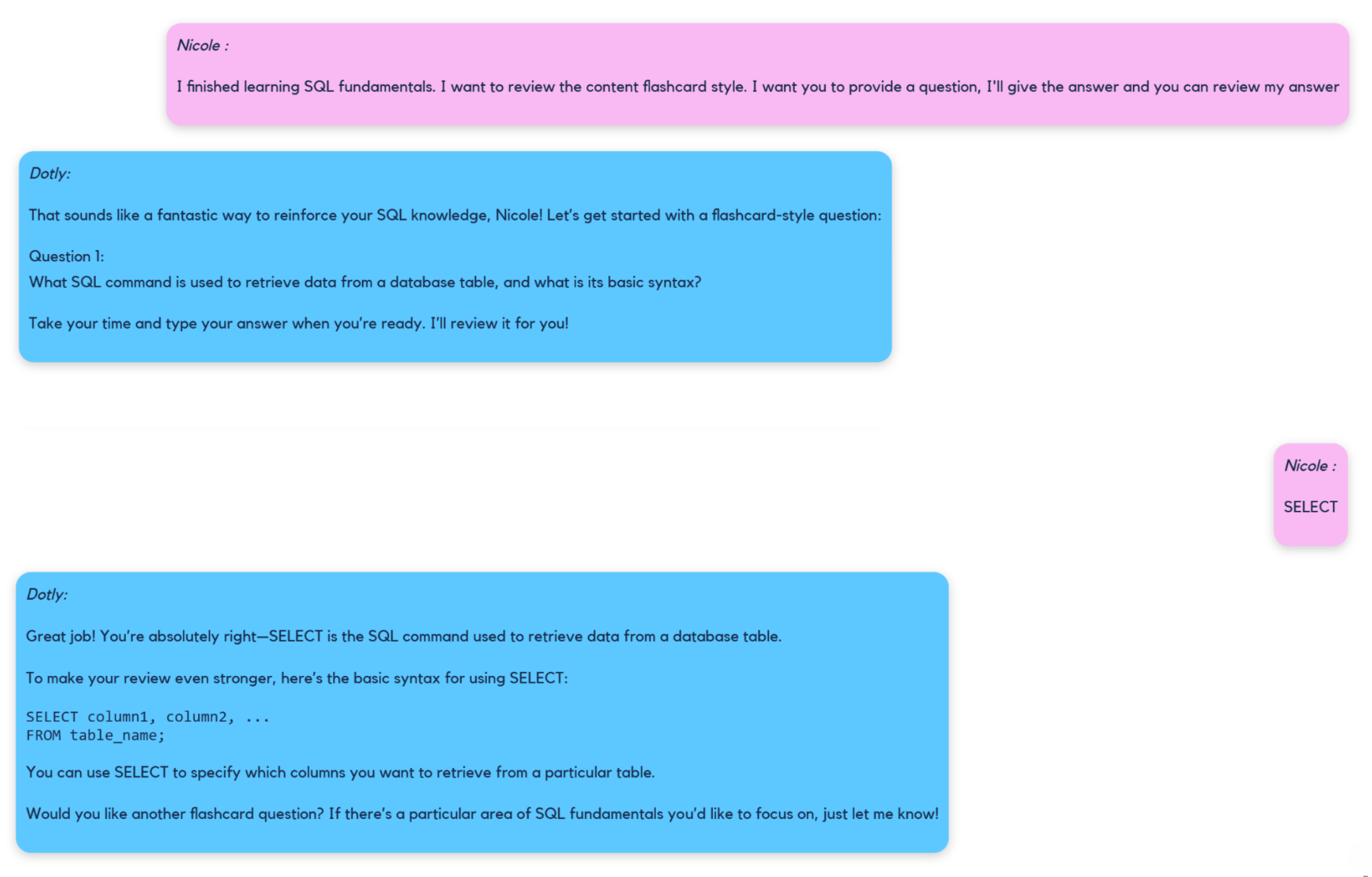
Active Recall example: using Dotly to review SQL Fundamentals content, flashcard style.
Just-in-time Learning
Just-in-time learning is about learning something at the moment you actually need to use it.
Imagine you are working on a spreadsheet and suddenly need to use a formula you cannot remember. You could redo the whole Google Sheets course that was assigned to you, but that feels like overkill. Just-in-time learning would mean looking up that specific formula, understanding it in the context of the sheet you are working on, and then using it straight away. It is perfect for people like me who are not great at memorising definitions and reciting them on command. Just-in-time learning gives new information context and a reason to matter, so it has a better chance of sticking to your brain.
How Can Dotly Help?
Thanks to our amazing developer, Amy, we can now chat to Dotly while reading through the lesson content.
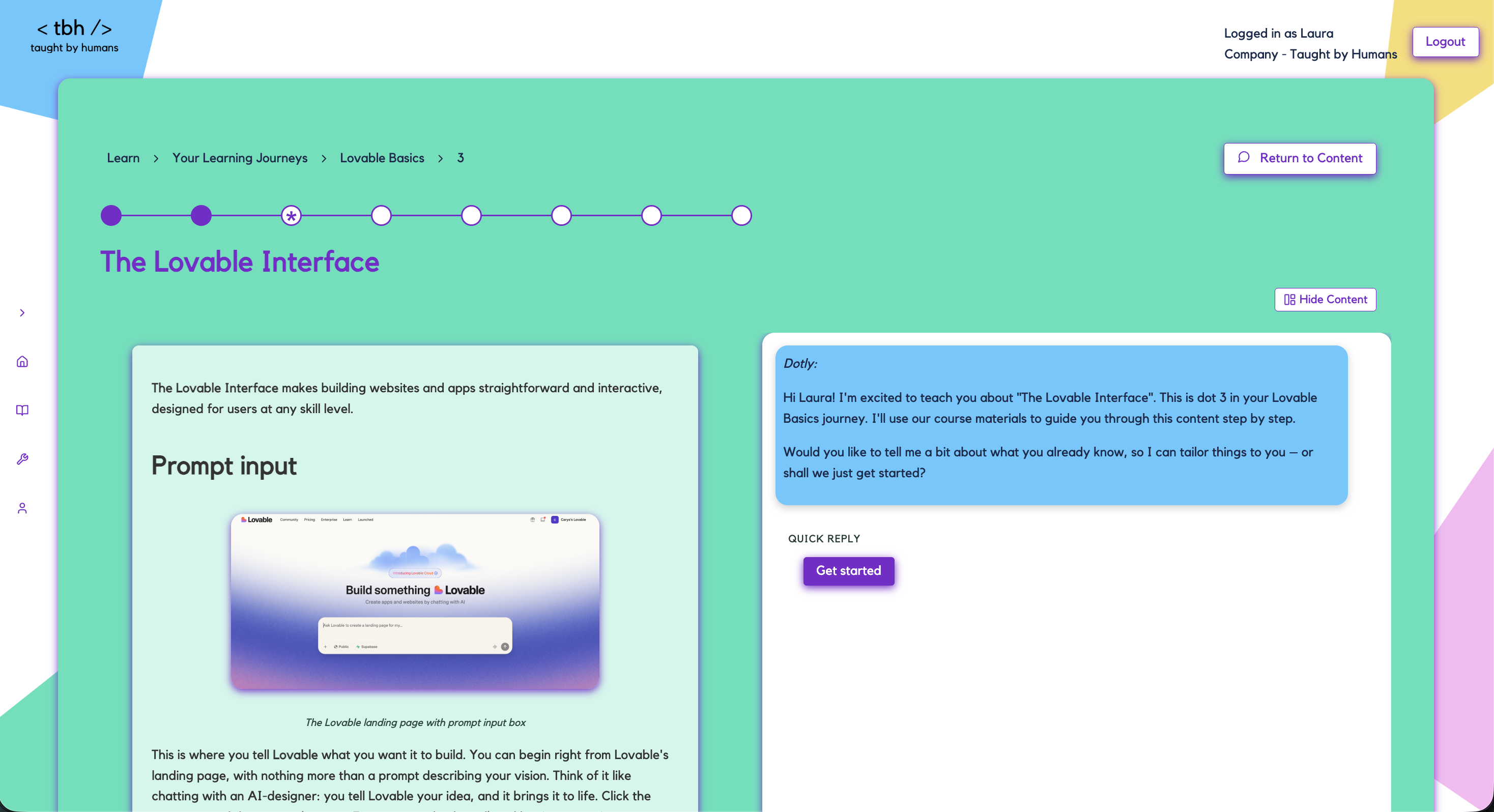
New Split Screen Feature on Taught By Human's Learning Platform
For example, when I was trying to learn more advanced SQL, I realised that one of the basic concepts had completely slipped my mind. It was SELECT.
Instead of opening a new tab and going down a search-engine rabbit hole just to find out what SELECT means, I could ask Dotly to help me then and there. Not only does this save me time and effort, but it also gives SELECT another chance to stick in my memory.
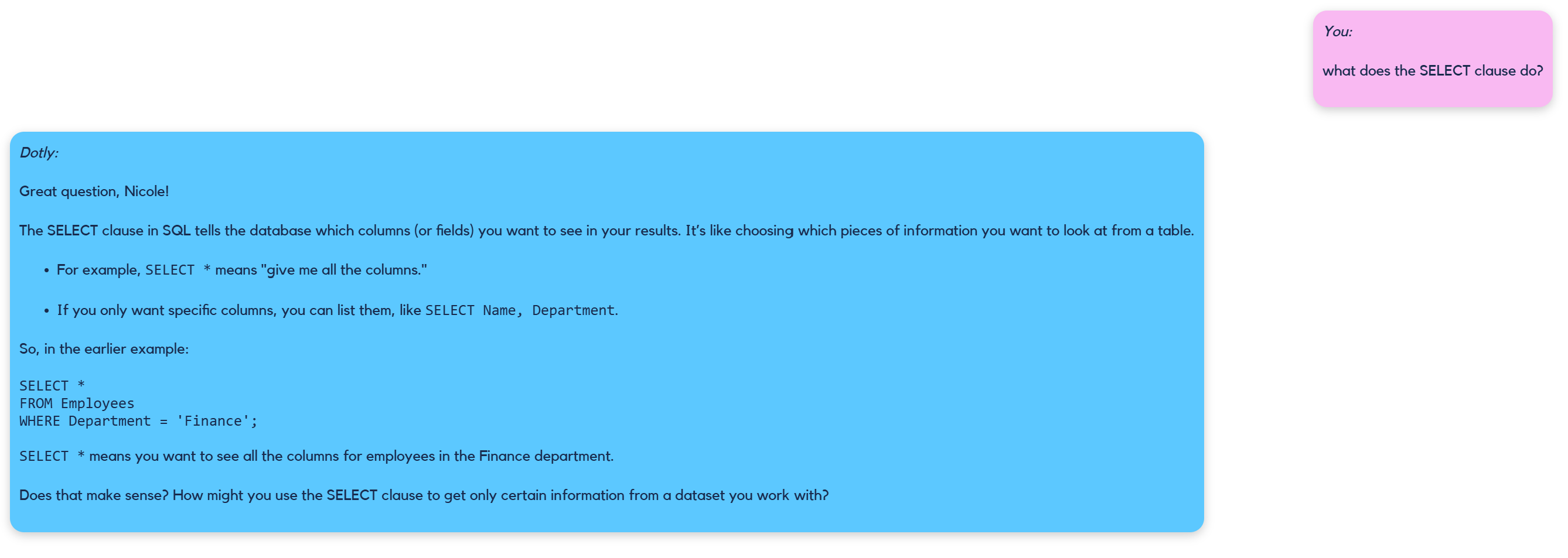
Just-in-time Learning example : using Dotly to explain the SQL term SELECT during a learning journey.
Engagement
Engagement is about making learning feel meaningful, useful, or connected to something you already know. When a concept feels relevant to you, your brain has more of a reason to keep hold of it.
Engagement in learning can come in lots of different forms, from quizzes and scenarios to drag-and-drop activities. But my personal favourite is using analogies.
I am not the best at memorising key words and definitions. If you asked me what SELECT, LIMIT and DISTINCT meant right after completing an SQL lesson, chances are I could recite their definitions perfectly. But ask me a week later, and my brain probably would not even realise you were asking about SQL.
This is where analogies help. Instead of trying to remember random terms in isolation, they connect the new information to something that already feels familiar.
How Can Dotly Help?
Turns out, Dotly is actually pretty good with analogies. This makes learning something like SQL a lot less boring. Recently, I have rediscovered one of my childhood favourite games: Minecraft. So, naturally, I asked Dotly to explain those SQL key terms using Minecraft terminology.
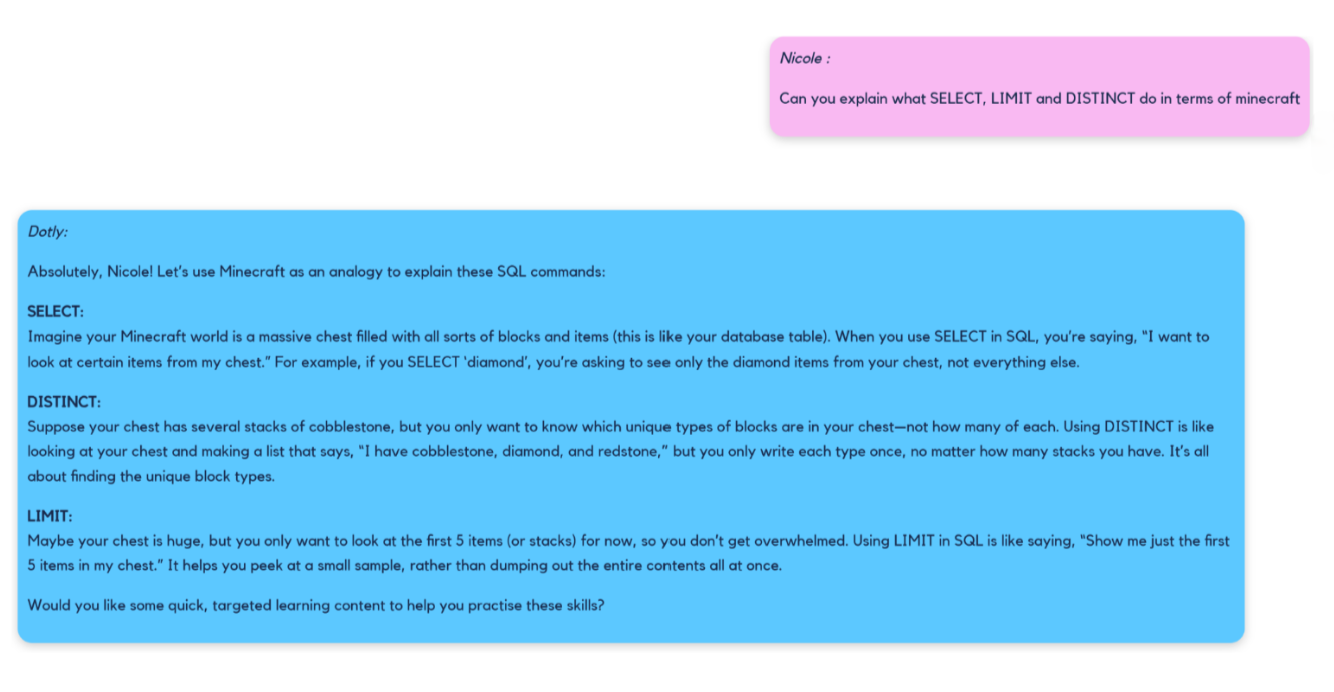
Engagement Learning example: using Dotly to explain SQL terms with a Minecraft analogy.
Now those terms are not just random words. They have a story and something familiar attached to them, making it much easier to come back to later.
Last Thing To Remember
I hope this has been useful, and that you go away and try some of these techniques for yourself. If they do not all work for you, I promise I will not take it to heart. Everyone learns differently, so the best thing you can do is experiment.