
I once went to a networking event and met a couple of wonderful people. A little while later, I saw them again at a different event and realised I had forgotten their names. Believe me, I felt terrible. It took me ages to remember one person's name, and unfortunately, the others never made it back. If my memory struggles with a handful of names after one event, imagine how it copes with the ridiculous amount of information in my yearly data privacy training.
For a long time, I put this down to having a terrible memory. But I know this happens to other people too, so surely we cannot all have terrible memories. That is when I did some research (partly to feel less guilt) and came across a psychological phenomenon called the forgetting curve. It helped explain why I seemed to forget things so quickly. Even better, it allowed me to discover ways to work around forgetfulness.
What Is The Forgetting Curve?
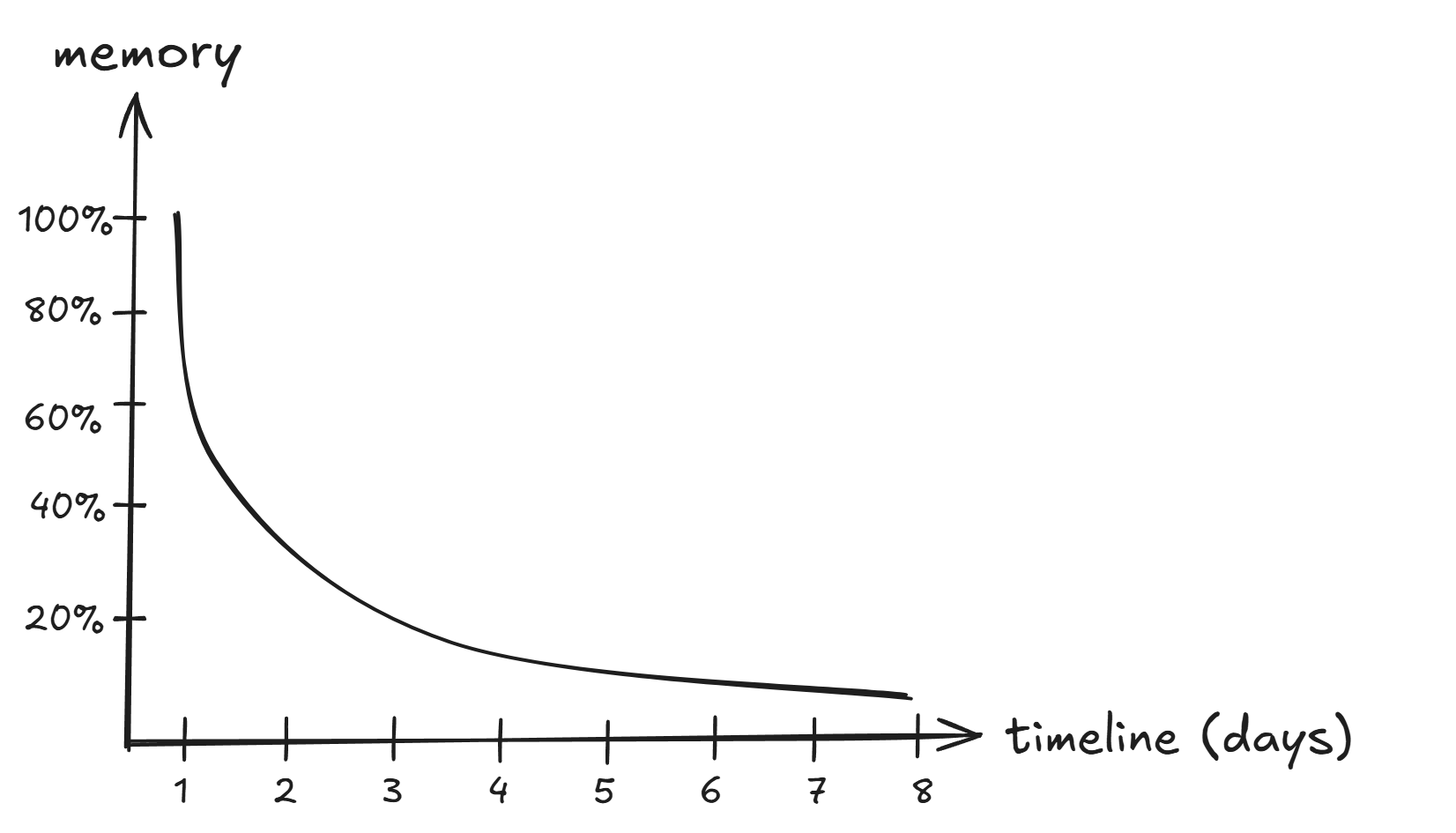
Graph of the forgetting curve: shows how memory declines over time
The forgetting curve is a graph that shows how quickly we forget information when we do not actively try to make it stick. It was developed by German psychologist Hermann Ebbinghaus in 1885.
The basic idea is simple: after we learn something new, our memory of it tends to fade quickly at first.
So, if I learned a handful of new names at a networking event, the curve suggests I would forget a large chunk of them pretty quickly unless I made an effort to reinforce them. Which, honestly, explains a lot.
What The Curve Cannot Tell Us
The forgetting curve is a useful way to understand memory, but do not take the exact timings as gospel. There are a couple of reasons for this.
We Are Not Hermann Ebbinghaus
Ebbinghaus conducted the original experiment on himself, which means the timings were based on his own memory and ability to retain information. And, annoyingly, everyone's memory is different. Some people can remember names and facts with very little effort. Others (like me) can forget a name while still actively shaking the person's hand.
What We Try To Remember Is Not Always Gibberish
Ebbinghaus used made-up combinations of letters, such as qob or xab, to test raw memory. This made sense for the experiment, but it is not exactly how memory works in everyday life.
In reality, the things we remember often have meaning attached to them. That meaning can change how well something sticks. For example, the person whose name I eventually managed to pull out of my brain was someone I had spoken to about our favourite cafes in Bristol. That conversation gave my brain something extra to hold onto.
Unfortunately, no universal curve can tell us the exact moment we will forget something. But the forgetting curve still acts as a useful reminder that memory needs reinforcement. Moreover, it led to the discovery of numerous methods for making information stick.
How To Remember Better
At Taught by Humans, these are some of the methods we find most useful.
Spaced Repetition
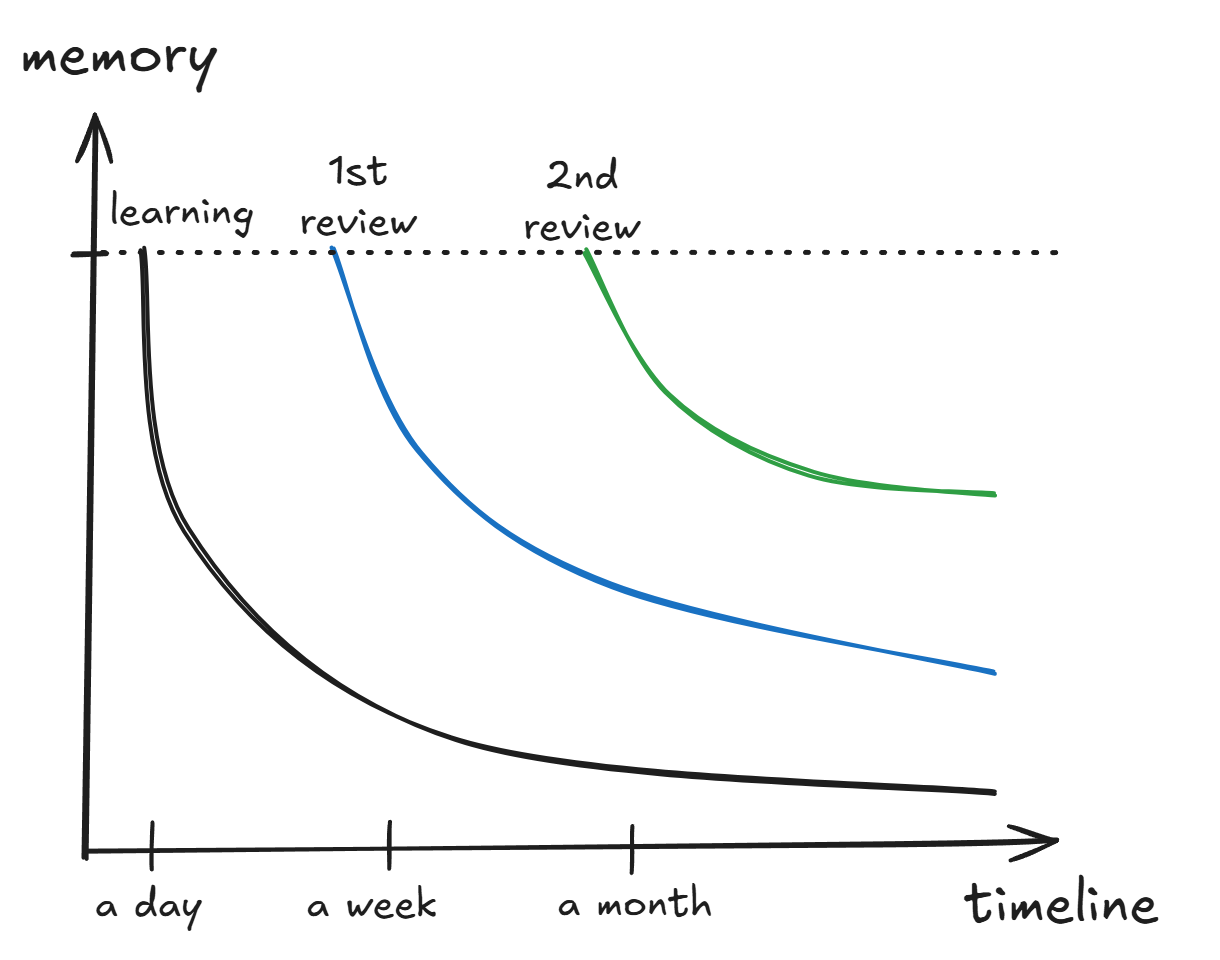
Graph of the forgetting curve with spaced repetition: shows how memory declines slower after each review
The main idea of spaced repetition is: when you learn something new, you review it again at gradually increasing time intervals.
In my case, after completing my data privacy training, I could revisit the key points the next day to give my memory a small boost. If I reviewed them again a week later, then maybe a month later, each review would help strengthen the memory.
Instead of letting the forgetting curve drop away completely, spaced repetition gives the information another chance to stick. Over time, the memory becomes more stable and easier to retrieve. Eventually, remembering what counts as personal data, or what to do before sharing information, becomes second nature.
Active Recall
Have you ever racked your brain trying to remember something?
What you are essentially doing is called active recall. Instead of simply looking at the answer, you are forcing your brain to practise finding the memory itself.
For example, if you are learning Excel, active recall would mean trying to write a formula before looking it up. You might ask yourself, How do I calculate the total again? or Was it SUMIF or COUNTIF for this? It might feel slower at first, but a little struggle will push your brain to retrieve the information for when you need it.
Think of it like driving the same route to work. The first few times, you may need a GPS. But after taking that route again and again, you start to remember it on your own. Similarly with active recall, the more you practise retrieving a memory, the easier it becomes to find it again.
Just-In-Time Learning
Back to my name-forgetting problem: if there was magically a post with everyone's name and photo before the next event. If I looked through it shortly before going, I would be much more likely to recognise people and remember their names when I saw them again.
That is just-in-time learning in action. The information is not floating around randomly in my brain waiting to be forgotten. It is learnt right when it is about to become useful. Basically, it gives my brain a reason to care before I embarrass myself with the classic we've met before, are you Jack? (It was in fact not Jack).
Engagement
The main idea behind engagement in learning is that information tends to stick better when it feels meaningful, useful, emotional, or connected to something we already know. When learning feels relevant, your brain has more of a reason to keep hold of it. Otherwise, it can end up as another random bit of information that slowly disappears from your memory.
Think back to the last time you had to complete data privacy training, or any other mandatory workplace course. Chances are, you were not just reading a chunk of text. You were clicking, dragging, choosing, or doing something with the content. In theory, that is engagement in learning. The aim is to stop you from passively scrolling through the material while your brain quietly wanders off. Unfortunately, in practice, engagement is not always well designed. There is a fine line between useful interaction and just being annoying.
Final Things (Before I Forget)
There is a lot more to learning than memory. Remembering something does not automatically mean we understand it, and it definitely does not mean we can use it well. But it does help to be able to recall information when we need to apply it. That is why reinforcement is key. If we want useful knowledge to stick around long enough for us to practise it, connect it and use it properly, we need to give our memory a bit of support.
So next time you are learning something new, do not just read it once and hope for the best. Try revisiting it later. Try pulling it from memory before checking the answer. Try connecting it to something familiar, like your favourite TV show.
Your brain may still forget things from time to time, because unfortunately that is part of the deal. But with a bit of reinforcement, it stands a much better chance of holding onto what matters.