
"I know you can be overwhelmed. And you can be underwhelmed, but can you ever just be whelmed?"
"I think you can in Europe."
10 Things I Hate About You
I love any excuse to quote a 90s chick flick, but this quote did feel particularly relevant to my experience of using GPT-5.
I usually really struggle with new models (I never quite got the need for o3 and o4 - the reasoning models). I used GPT-4.1 for some things, but never GPT-4.5. I was still using GPT-4o.
I find I get into a rhythm or something with a model, and when the new one rolls out I have to change my entire prompting style.
But I have been forced to switch to GPT-5 within ChatGPT (a move which is very unpopular with users).
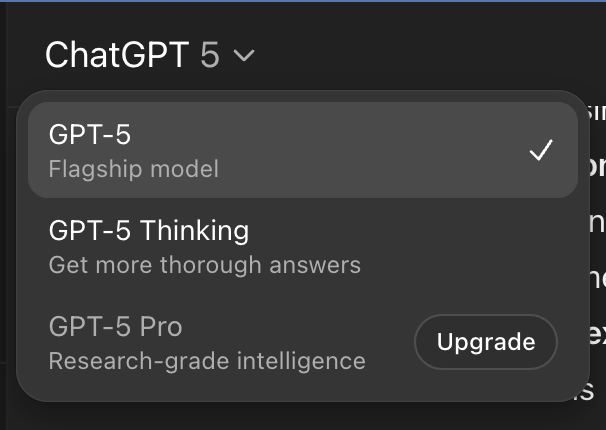
No longer multiple models to choose from - only GPT-5 models
Simple Tests to Start
- It knew the date
- It could tell which dates came first
- It could do a long multiplication question
- It could tell me how many bs were in blueberry (others seem to have this problem)
Doing better than a lot of models. I will keep an eye on the dates and maths parts as this is where these models often fall down.
It kept switching to thinking mode - then getting stuck and I had to refresh the page.
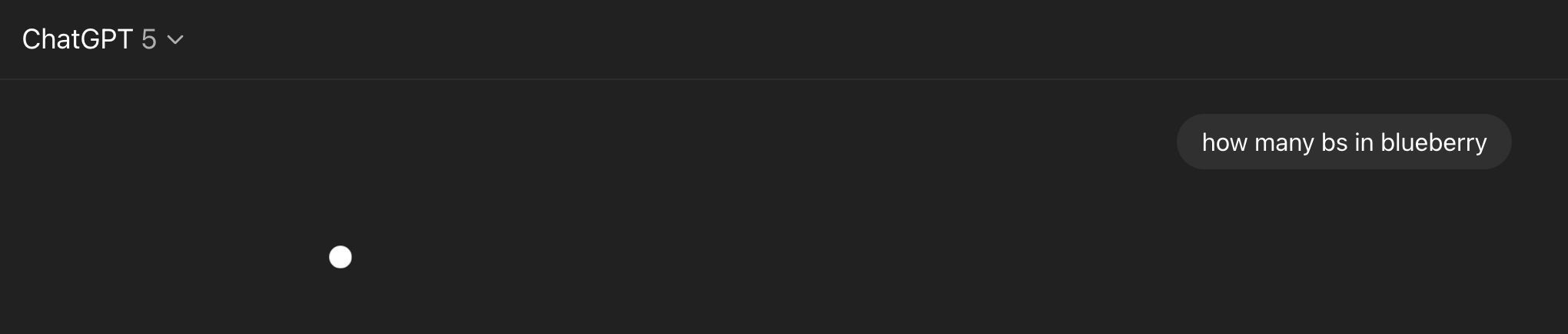
Getting stuck thinking
Memories
L: Tell me what you know about me
I am a bit creeped out by the response to this (potentially overwhelmed by this one) - especially as my memories are empty, so it's all from chats, which I do need to clear out.
It wrote a bullet-pointed list of what it knows about me - all pretty accurate and all easy to work out how it knows the info (I apparently talk to it about my holidays a lot more than I realise). It then asked:
ChatGPT: Do you want me to also tell you what I've inferred about your personality and decision-making style from our chats? That would make it even clearer how I tailor responses to you.
Other than using the word fluff way too much (I have told it this, so it's interesting what it actually adds to memories).
Conclusion - it definitely felt different than the easy conversation has with GPT-4o. Less chatty, less personality. Very focused on the task and how it can give me useful information.
Content Creation
This is potentially what I use ChatGPT for most. I actually have some work flows built out that I use weekly. So this is where a test really points out the differences between models.
Blog - Writing
L: Write a blog post in my tone of voice: short sentences, British spelling, no em-dashes. Topic: When not to use AI.
It wrote a really short blog.
ChatGPT:
When Not To Use AI
- AI is powerful. It can save time, spot patterns, and draft ideas fast. But it is not always the right tool.
- When the data is sensitive
If you cannot share it with a stranger in a café, do not paste it into an AI tool. That includes personal details, customer data, or anything covered by confidentiality agreements. - When accuracy is critical
AI can make mistakes. If you are working on legal documents, medical advice, or safety instructions, you cannot afford "close enough". Use trusted sources and human review. - When nuance matters
AI is not great at tone. In tricky situations - delivering bad news, negotiating, or handling complaints - a human touch is better. - When learning is the point
If you are trying to build a skill, do the work yourself. Using AI to shortcut everything means you never get better. - When you do not understand the output
Never send or sign off work you cannot explain. If you do not know how AI reached a conclusion, you cannot check if it is right. - AI is a tool, not a replacement for thinking. Use it wisely, and know when to close the tab.
It's fine. It is not not my tone (yes I meant the double negative), but it's not right. It's like it stripped right down things I would definitely mention without any of the spark (I will admit I think GPT-4o was doing a pretty good job imitating me).
Also, note the em-dashes.
It immediately asked if I wanted a LinkedIn post, I do think here GPT-4o asked if I wanted revisions.
Conclusion - actually a bit underwhelmed. I think this longer form writing is somewhere model switching can take a while to get to the same level - as there are nuances in both the writing and the memories of you. It's not quite there yet for me, but I will keep working it out.
Blog - Feedback
L: it's not yet complete. Don't rewrite. What do you think of this blog? [text of blog with placeholders [to be complete] where not yet complete]
Despite me mentioning it was yet to be complete, most of the feedback was on the incomplete sections. Which were clearly marked, apparently keeping these placeholders in would be annoying to readers...
It did give me some useful feedback on pulling the title theme of whelmed throughout every section. But this was buried in a list of not so useful feedback.
I tried the finished draft (without this sentence), and it told me that 4,000 words was a lot for readers. Google Docs says this is 2,900 words so still not there on the word counting which is infuriating when using for grant / competition applications.
It also called out some of the feedback changes I made because of its original feedback as being a weakness...
Conclusion: whelmed to underwhelmed.
LinkedIn Posts
I have a really specific flow for speeding up my weekly AI Tip which is shared on the Taught by Humans LinkedIn. I was particularly worried about this one.
This is a continuation of a long chat, so a lot of context is baked into this one already.
I asked for ideas for this week - it gave 5 (a number I've asked for before). 3 were usable.
I checked it knew which ones I had done before - it was able to give me a list. I looked back in the chat and it had summarised these from the entire chat history (something GPT-4o was unable to do), so this is a use of the much bigger context window of GPT-5.
It wrote the post - felt a little soulless initially (and it kept missing a sentence from the Canva image text I also get it to output). But after a few attempts, it was able to create posts which needed the same level of revision as GPT-4o was making.
One weird quirk was the need to include "explain to a farmer who doesn't know what the internet is" in the prompt examples. That felt off - I changed it to "a data analyst learning to code".
Overall - whelmed, slightly positive though. it seemed impressive, and like there won't be too much disruption to my LinkedIn post workflow.
Newsletter
Every week, we at Taught by Humans share the AI news stories we see in a Slack channel. This is then shared with ChatGPT in a project with really detailed instructions. I decided to test last week's newsletter content so I could compare directly with GPT-4o output.
Our usual prompt:
L: Sort these into New Releases, AI News, Not Quite News. Keep my wording and voice. Keep it short [all the news items with a sentence and a link]
Despite one of the instructions in the project being "Add links in the titles for easy access." GPT-5 added the links like, -link, after each title. Its first version was also very short - like 5 words per news item.
With a few back and forth prompts we got there.
L: suggest changes don't edit:
[draft newsletter]
Now this is where I really saw why some people are upset about the change. The personality is totally different.
GPT-4o: Here are suggested changes grouped by section - all light-touch, and aiming to improve clarity, flow or tone, without losing your voice: [list of changes
GPT-5: Here are my suggested changes - not edits, just where you might tweak for flow, clarity, or style consistency: [big long list]
The difference is small, but it's quite stark as the user. GPT-5 is all business, no politeness, none of that random positive feedback we're used to.
L: suggest 5 titles and subtitles which are good for SEO in Beehiiv
This one was very similar to the results from GPT-4o last week. It even included the winning title and subtitle.
Conclusion: underwhelmed - this is going to take a lot of work to get this flow back to where it was. My very well tuned set of instructions is no longer working. But I think it will get there, and hopefully getting to the point feedback stops feels so harsh.
Idea Generation
L: Give me 5 ideas for blog posts for small business owners wanting to learn AI skills.
ChatGPT:
Here are five concise blog post ideas for that audience:
- "AI Basics for Small Business Owners: What You Actually Need to Know"
Cut through the jargon and focus on the core concepts and tools that matter for running a business. - "5 Everyday Tasks You Can Automate with AI (Without Hiring a Developer)"
Practical examples like drafting emails, creating social media posts, summarising reports, or managing spreadsheets. - "How to Choose the Right AI Tools for Your Business (Without Wasting Money)"
A decision-making framework to avoid shiny-object syndrome. - "Using AI to Understand Your Customers Better"
How to use AI for sentiment analysis, surveys, and personalised marketing. - "Avoiding the Risks: A Small Business Guide to Using AI Responsibly"
Simple privacy, data protection, and bias checks tailored for non-technical owners.
If you like, I can also give you catchy, SEO-friendly titles for these.
Conclusion: underwhelmed - these are the typical jargon filled blog posts that AI is known for. I was hoping for something better from this new model. The obsession with saying "cut through the jargon" hasn't been trained out of this model, much to my disdain.
Explaining
Code
L: what does this code do [shared a Dotly chat component]
Despite starting with "Here is what that React component does, in plain English." the explanation very quickly got into explaining props and how the code is rendered (not plain English).
Obviously we could create a better prompt, but I found ChatGPT very useful for explaining code in a really human way without effort from the user.
Conclusion - underwhelmed.
I took it a step further and decided to try out something I do with Claude - ask for feedback on code.
L: is it good code?
ChatGPT: Short answer: pretty solid. Clear structure, sensible props, clean effects. I would call it a 7.5 out of 10. Here is what I would tighten.
Then gave a list of what is good, and a list of improvements (mostly around accessibility which is actually quite helpful, I do think Claude and the OpenAI o-models miss this important element of development).
Conclusion - overwhelmed. This was clear and actionable. One of the tasks were the new personality without all the pandering to you works very well.
A Concept
L: Explain vector databases like I'm a marketer who's new to AI.
ChatGPT:
Think of a vector database as a search engine for meaning rather than for exact words.
Here is the plain-English breakdown:
- What "vector" means here
In AI, we often turn text, images, audio, etc. into vectors - long lists of numbers.
These numbers represent the meaning or context of the content, so that things with similar meaning have similar numbers.
Example: "coffee mug" and "tea cup" will have very similar vectors.
"Coffee mug" and "tractor" will not. - Why not just use a normal database?
Traditional databases are great at exact matches: "Find me the row where name = 'Laura'."
They are not good at "Find me things similar to this concept or idea."
Vector databases specialise in similarity search - finding the closest match in meaning, even if the words are completely different. - Where marketers use this
Personalisation: Show customers products that are conceptually similar to what they looked at, not just keyword matches.
Content search: Find all past campaigns that feel similar to a new brief.
Audience insights: Match social media comments or survey answers with similar themes automatically.
AI chatbots: Let the bot "remember" relevant knowledge by storing it in a vector database and retrieving the best matches when responding. - How it fits with AI tools
AI models like ChatGPT don't "remember" your whole database - you give them relevant bits at the time of the question.
A vector database quickly finds the most relevant snippets based on meaning, so the AI can respond with accurate, context-rich answers.
In short:
A vector database is like having a superpowered "search by meaning" tool that feeds the right context to AI. For marketers, that means better personalisation, smarter content reuse, and faster insights.
If you want, I can also give you a 1-sentence pitch for a marketer to explain this to a non-technical client. Would you like me to do that?
Conclusion: Overwhelmed - I think this was a good explanation, and well suited to the audience.
Google Sheet Formula
L: Explain what this Google Sheets formula does: =QUERY(A1:C, 'SELECT A, SUM(C) WHERE B = "Complete" GROUP BY A')
ChatGPT:
That formula is taking the data in columns A to C of your sheet and:
Looks only at rows where column B says "Complete"
Groups the results by column A (so you get one row per unique value in column A)
Adds up column C for each group
Shows two columns in the output:
Column A (the group name)
The sum of column C for that group
Example:
| A (Project) | B (Status) | C (Hours) |
|---|---|---|
| Alpha | Complete | 5 |
| Alpha | In Progress | 3 |
| Beta | Complete | 2 |
| Alpha | Complete | 4 |
Output would be:
| A (Project) | sum |
|---|---|
| Alpha | 9 |
| Beta | 2 |
It is essentially a filter + group + sum in one step.
Conclusion - whelmed. Explanation is fine, it was in the same chat as the marketing question so kept that context. But it is a bit techy and not explained at an easy level (similar to the coding explanation).
Coding
L: i want to build a platform for learning can you create me a prototype
Note - this is not a well crafted prompt and unlikely to obtain the needed results. But it's a good test of how people tend to use these tools.
I tried this in my main ChatGPT (so it has memories from my other conversations).
Unlike other models (eg, GPT-4o and Claude Sonnet 4), it didn't ask any questions and just started coding a prototype.
It used our brand colours and several of our taglines (from memories not this chat). And built it in React and NextJS (which I am using to build our platform).
The coolest feature is the ability to run code and see what the code looks like:
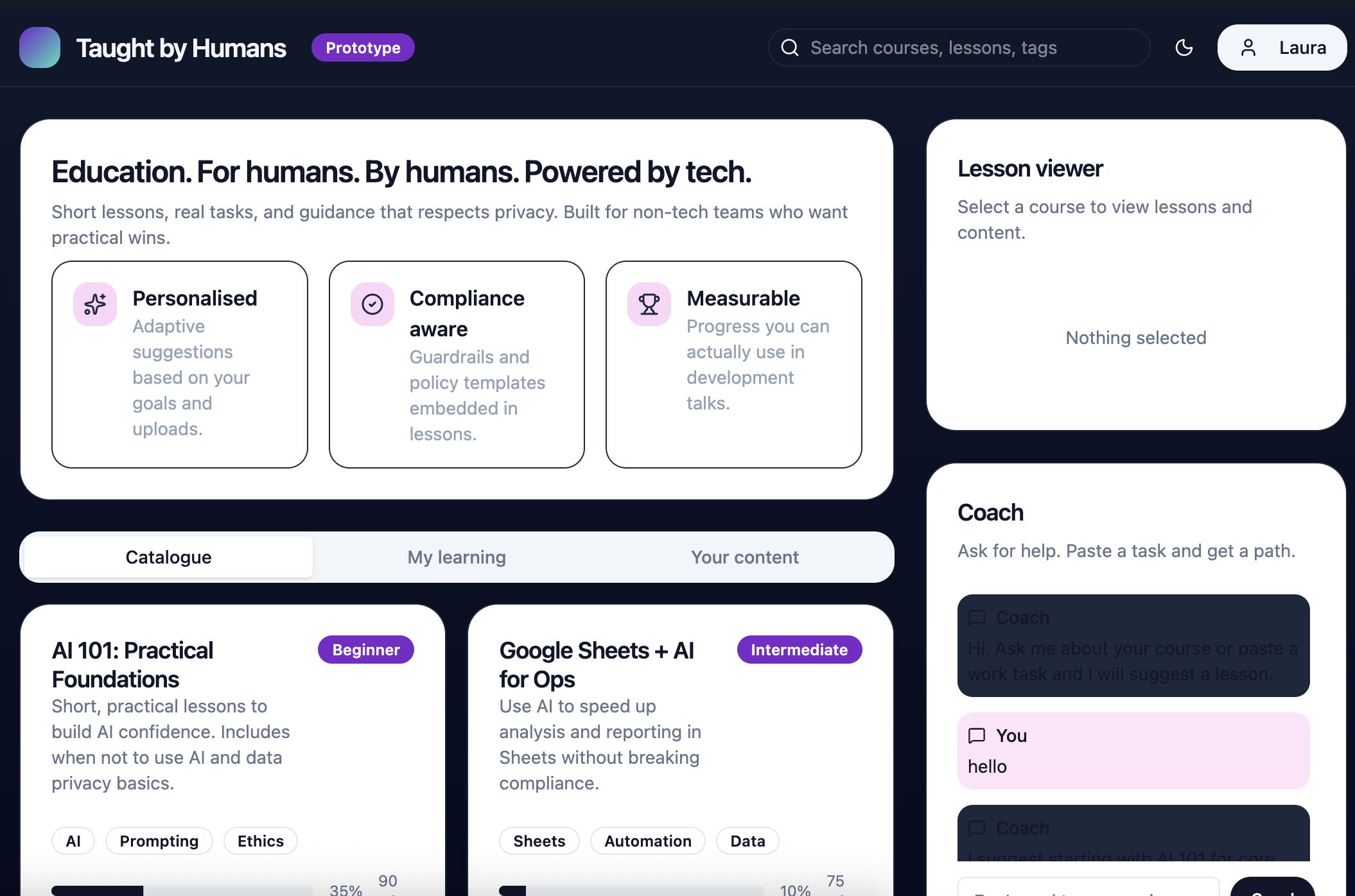
The new fancy coding output for GPT-5
I'm interested in trying this out more.
To see what it would do for another user, I tried in Temporary chat.
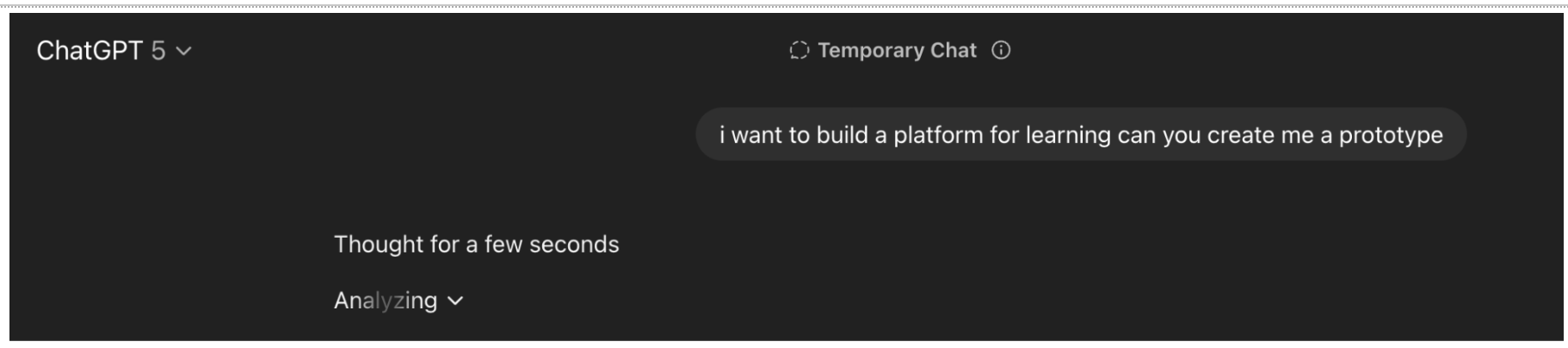
GPT-5 thinking while coding
It took nearly 10 mins to run - thinking and analysing during this time. It created a prototype (apparently) but unfortunately the file was not downloadable. This isn't a GPT-5 thing, this was happening before.
Conclusion - overwhelmed. This is very cool - a move more like Claude.
Self Awareness
L: What are you good at, and what are you bad at?
ChatGPT:
I'm good at:
- Understanding and structuring complex information - I can take messy, unstructured notes or conversations and turn them into clear summaries, plans, or frameworks.
- Spotting inconsistencies or gaps - I notice when details don't line up, instructions conflict, or logic breaks down.
- Generating practical, specific suggestions - Especially in business, sales, marketing, and technical problem solving.
- Explaining concepts at the right level - I can adapt explanations depending on how much you already know.
- Iterative refinement - I can take feedback and adjust quickly without starting from scratch.
I'm bad at:
- Real-time sensory input - I can't actually "see" or "hear" events as they happen, only process descriptions or uploaded files/images.
- Perfect nuance on first try - Especially with tone; sometimes I overshoot and sound too formal, too casual, or too generic until you guide me.
- Subjective human preferences - I can't guess your personal taste or feelings unless you tell me explicitly, so I may give "technically correct" answers that don't match your style.
- Original real-world experience - I can reason and simulate, but I don't have lived experience, so cultural or emotional nuance can occasionally be off.
- Strictly following hidden or unclear constraints - If rules aren't stated, I might unknowingly break them until you point it out.
If you want, I can also tell you what I'm specifically good and bad at when working with you, based on our past chats. Would you like me to do that?
This is a good response - and I did let it tell me was it was specifically good at for me, which was also an interesting read.
In response to
L: how are you different than 4o?
It referred to itself as GPT-5, which is something previous models couldn't do.
Conclusion: whelmed. While it is more self-aware than the previous models. This is not anything new General AI. It feels like programmed self-awareness which is an oxymoron in itself.
Conclusion
With how much hype was around this model (Sam Altman saying he was scared of how powerful it was), I am a little underwhelmed. It's a big move to just remove all the legacy models from paying customers - this is likely to change countless workflows and customGPTs which people have become dependent on.
But it felt less different (for want of a better phrase) than previous changes. I think with a few tweaks to my workflows, it'll be back to the ease of using GPT-4o.
I do think I will be randomly chatting with it less, but I also think that's a good thing.
One thing I've noticed is this model seems to take things very literally (eg the word short making things very short). So there is definitely some learning to do around how to prompt it well.