
At Taught by Humans, we’re all about AI and education, especially in the workplace. More and more of us are turning to chatbots to teach us new things: “I need a list of project management principles I can use to keep my team on track”; “teach me how to use Canva to create a brand identity”; or “remind me how to use VLOOKUP” (this one often comes up in our workshops!)
Chatbots can be handy when you’re in a rush, and don’t fancy sifting through jargon-heavy technical guides or watching a whole YouTube tutorial for the 10 seconds that are actually relevant. In the news this week, Estonia has announced that it’s going to be pushing AI hard in classrooms, with the aim of freeing up teachers for emotional support, mentorship and fostering creativity. I’m a qualified teacher myself and have experimented previously with its chances of taking my job. But with so many of us reaching for chatbots to learn something new, my question was: is ChatGPT actually a good teacher?
Lesson 1: Teaching 101
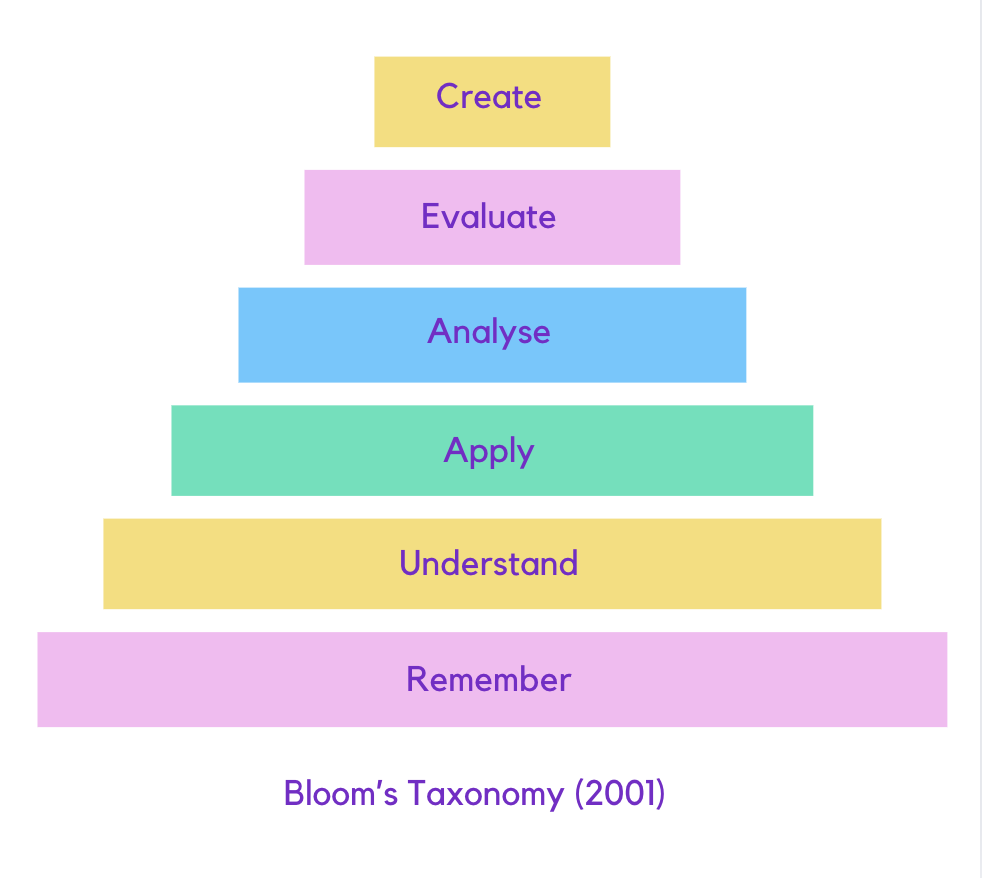
Bloom’s Taxonomy (Anderson, L. W., & Krathwohl, D. R. (2001))
Bloom’s Taxonomy is Teaching 101. It classifies different orders of thinking, from your basic recall (What is a formula in Google Sheets?) all the way up to creating new ideas (Design a simple data dashboard using spreadsheet tools that could help track weekly sales). ChatGPT didn’t need to be told this though: it gave me a handy breakdown of the theory and its history.
C: Hi, tell me what you know about Bloom's taxonomy and how it can be applied to questioning and assessment.
ChatGPT: Bloom’s Taxonomy is a hierarchical classification of different levels of thinking, developed by Benjamin Bloom and his colleagues in 1956 (later revised in 2001 by Anderson and Krathwohl). It’s commonly used in education to design learning objectives, frame questions, and assess student understanding at various cognitive levels.
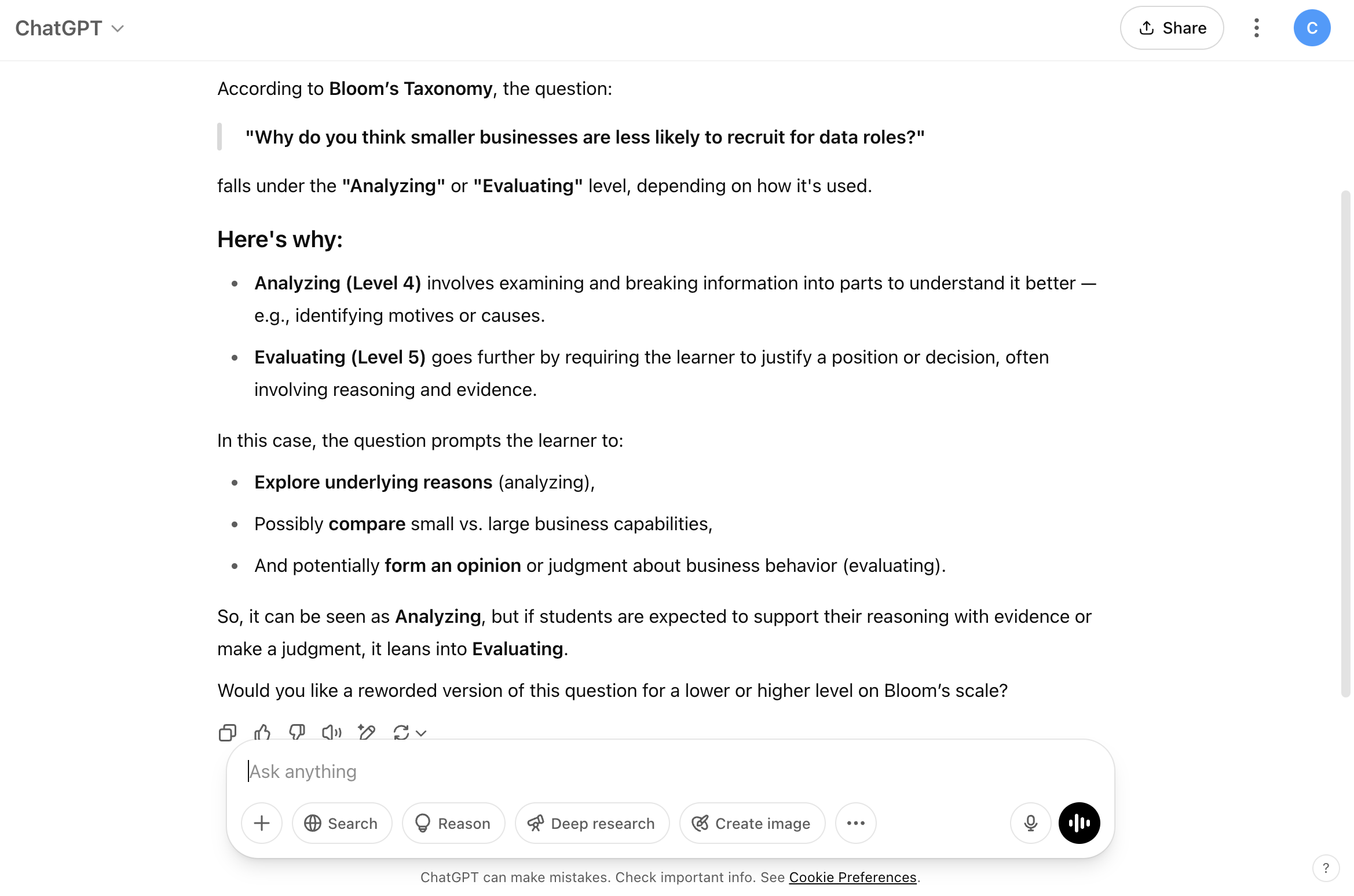
ChatGPT summarised the original and updated Bloom’s Taxonomy
Lesson 2: Applied Educational Theory
Before I put its own teaching skills to the test, I was interested to see whether ChatGPT could think at the different levels that Bloom’s Taxonomy describes. I sent it an extract from the Quantifying the UK Data Skills Gap report, and started with the basics.
C: How many data roles need to be fulfilled?
ChatGPT: Great — this is a "Remembering" level question in Bloom’s Taxonomy, as it asks for a recall of factual information directly from the text.
Answer:
Between 178,000 and 234,000 data roles potentially need to be filled in the UK, depending on how broadly data roles are defined.
Would you like to try a question at the next level — Understanding?
ChatGPT passed the first test with flying colours. I’m not sure how I feel about being congratulated on the quality of my question, but our chat did take place during ChatGPT’s over-friendly phase.
It performed equally well with an “understanding” question, but the wheels started to come off around “applying:”
C: Use the statistics in the report to suggest the greatest concern in the workforce
ChatGPT: Great — this is an "Applying" level question, as you're being asked to use data from the report to identify and interpret a real-world implication.
Answer:
Using the statistics provided, the greatest concern in the workforce appears to be the difficulty in filling data-related roles despite high demand. The report notes that up to 234,000 data roles potentially need to be filled, yet 46% of businesses have struggled to recruit for such positions. This recruitment challenge is especially acute for larger businesses, where over half (55%) report difficulty. Furthermore, key roles like data analysts and heads of data are among the hardest to fill. This mismatch between demand and available talent suggests a significant skills gap, which could hinder business growth, innovation, and the UK’s broader digital economy.
I might be overly-critical here, but I had higher expectations of my pupil. Sure, ChatGPT has correctly identified the greatest concern, but it seems a little unsure of itself. The biggest concern might “appear” to be recruitment of data-related roles, but it’s then given me a list of sub-concerns too.
Unfortunately, I can’t blame ChatGPt here - a lack of commitment is part of what it is. Large language models (LLMs) like ChatGPT are built on predictive algorithms to give an answer that seems most likely from a language standpoint. Its answers should sound plausible, but they’re based on huge datasets that contain a mountain of opinions and interpretations.
I asked it to summarise its answer in one sentence, and I was happier with the response.
C: Can you give a one sentence answer please?
ChatGPT: The greatest concern in the workforce is the significant skills gap, shown by the high number of unfilled data roles and the widespread difficulty businesses face in recruiting for them.
We also had a bit of a disagreement over my “evaluating” question:
C: Can you predict how a similar study might look in ten years time. Do you envisage the gap getting larger?
ChatGPT: Great — this is a "Creating" level question (though it also touches on Evaluating), as it involves forecasting and generating new ideas based on trends.
One-sentence answer:
In ten years, a similar study may reveal an even greater demand for advanced data skills, especially in AI and automation, and unless education and training systems adapt rapidly, the skills gap could widen further.
Would you like help formulating questions at each Bloom’s level for your own use?
I understand ChatGPT’s reasoning. In many ways, I am asking it to generate a new idea. But a prediction isn’t plucked from nowhere, it should still be rooted in the source material and informed by familiar patterns.
On a deeper read, the answer is actually pretty flimsy too. I’ve asked for a prediction, but all ChatGPT has done is hedge its bets again. I don’t want it to tell me what “may” or “could” happen, I want it to commit to a possible outcome, and back it up convincingly with the facts it’s based on.
Overall, ChatGPT fared well but these small hitches are a reminder that chatbots aren’t actually thinking like humans at all.
Lesson 3: The Student Becomes the Master
As ChatGPT had been so eager to give me feedback on the quality of my questions, I wanted to see how it handled the role of teacher. After all, the ability to generate different levels of questions would allow L&D managers, educators or independent learners to test understanding and probe for weaknesses in a fraction of the time.
C: Ok, now that I've asked you a series of questions following Bloom's Taxonomy, please could you devise a set of questions about the same excerpt that follow the same order?
ChatGPT: Absolutely! Here’s a set of questions based on Bloom’s Taxonomy, tailored to the excerpt you provided:
- Remembering (Recall facts) How many data roles are estimated to need filling in the UK?
- Understanding (Explain meaning) Why do you think smaller businesses are less likely to recruit for data roles?
- Applying (Use information in a new context) If you were a business owner, how would you address the challenge of recruiting for data roles, based on the information in the report?
- Analyzing (Break down ideas into parts) Compare the recruitment challenges faced by large businesses versus smaller businesses based on the report.
- Evaluating (Judge or critique information) Do you think the recruitment difficulties for data roles will improve in the near future? Why or why not?
- Creating (Generate new ideas or propose solutions) Imagine you are designing a new education program to fill the data skills gap in the UK. What key skills would you focus on, and how would you make the program accessible to more people?
It’s not bad at all. ChatGPT has given me a range of questions that test different levels of thinking. It also pulls on different sections of the report extract, which is a clever way of double-checking a learner is familiar with all of the content, and not just an expert on a small section.
I’m not happy with the “understanding” question. It requires a wider knowledge of the topic that goes beyond comprehension of the report. Funnily enough, in a newly opened conversation, ChatGPT also agrees that is actually quite a bit more challenging:
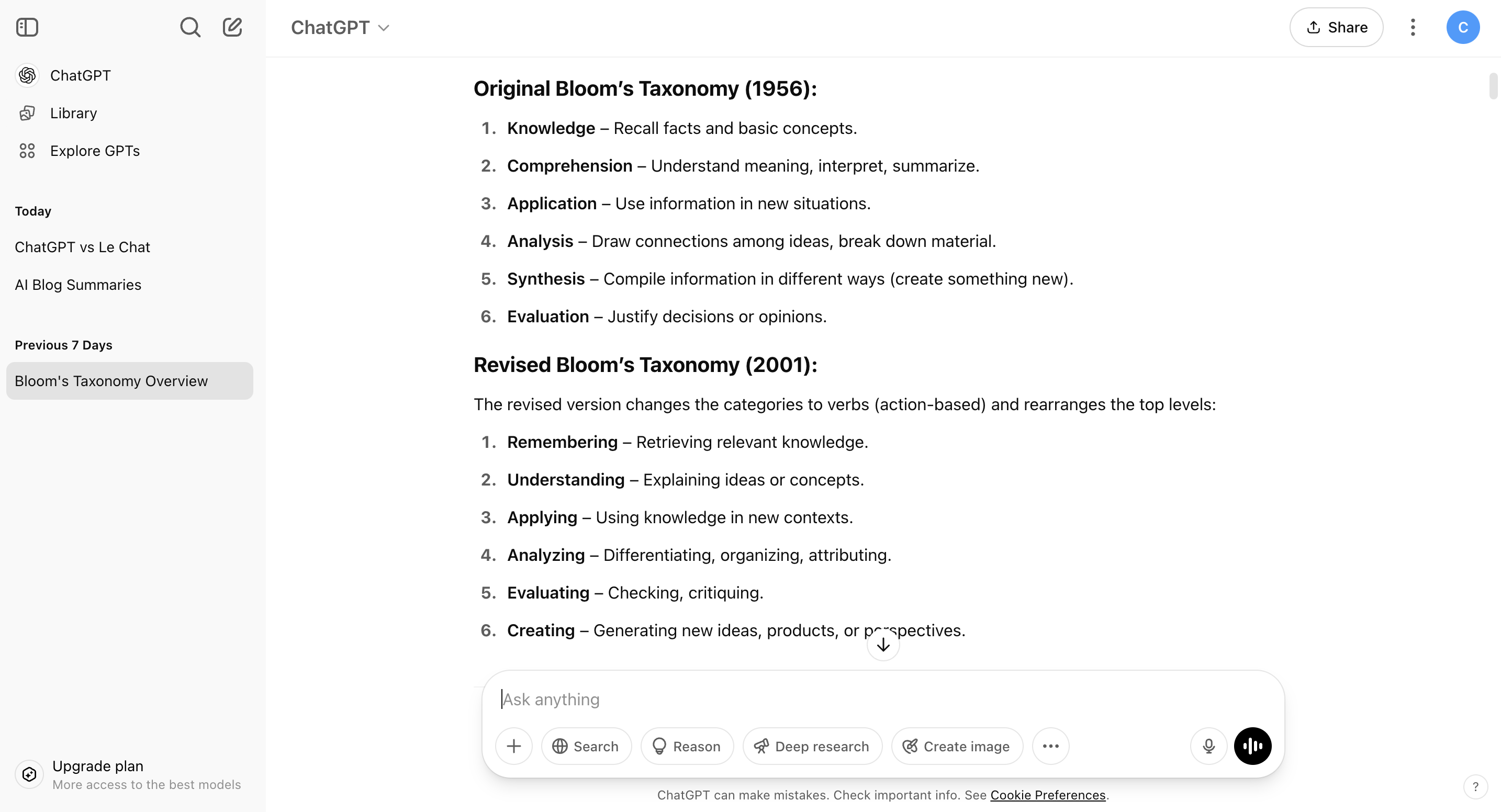
ChatGPT corrects its own mistake in another chat window
Is ChatGPT a Good Teacher?
Part of being a good teacher involves understanding your students and how they think. However good ChatGPT might be at mimicking human interaction, it doesn’t really get us, and it can’t understand how we think because it isn’t actually thinking at all. In workplace scenarios, it’s a great alternative to a Google search for a wordy blog. Most of what we’re asking a ChatGPT to help us with at work would fall into “remembering” or “understanding,” and it dealt well with these demands.
In my own teaching and learning experiences, ChatGPT’s main downfall is that it doesn’t follow a curriculum (always easy to catch a pupil out for using a chatbot to do their homework when they’ve included some degree-level geography in their Year 5 diagram of the water cycle…). I’ve just used the free version of the chatbot (that’s what most of our workshop users are playing around with). However, education has been the talk of the town in the AI world for the last couple of months with Anthropic, Google and OpenAI all launching research or education-specific models.
The pull of a chatbot over conventional content is always going to be personalisation. So, what if your workplace learning involved the familiarity and flexibility of a chatbot, with the reliability of role or skill specific content? Here at Taught by Humans, our platform does just that, teaching you exactly what you need, in a way that works for you.