
The UK government has identified construction as a key industry that could be doing lots of more with AI, but isn’t yet. While 21% of UK companies had adopted AI last year, only 12% of construction companies were using AI tools regularly. And while 22% of the overall UK workforce received AI training, only 5% of construction workers had this opportunity. (That’s according to Ranstad Employer Brand Research 2025.)
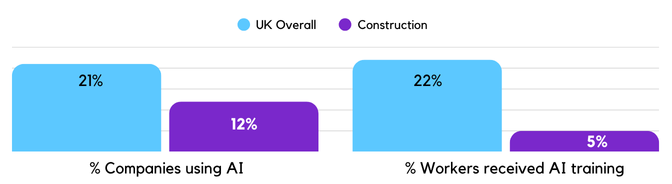
AI adoption and training levels compared to UK overall
Why is Construction so Important?
The construction industry contributes £132 billion to UK GDP (Gross Domestic Product) every year based on ONS figures, making up 6-7% of the total. Over 2 million people work in the industry, including architects, engineers, surveyors, site managers and builders. It plays a major role in the UK economy, but the sector has been slow to get on board with new tech like AI.
The Bridge AI programme run by Innovate UK makes AI more accessible to the UK's construction sector, providing funding and technical support. We’re delighted to say that Taught by Humans has received grant funding to adapt our AI learning platform specifically for the construction industry, and we’re currently deep into the research phase of the project.
We’re looking to better understand how AI is being used in construction - and importantly how people are learning about it. We’ve started by finding out what’s happening in the world of Construction Tech (ConTech), and it turns out there are many AI tools built for construction, they’re just not widely used - yet.
What Have We Learnt So Far?
ConTech is a growing area with many new companies, particularly in the US, but also in the UK, starting up from 2016 to the present, according to ChatGPT. Why 2016? Rapid advances in AI and mobile tech, a wave of venture funding that suddenly made innovation possible, and new safety and sustainability regulations all came in around this time.
AI software for the construction industry covers health and safety, compliance, measurement and fitting tools, and much more. Construction project management seems to be the most common from our research (not too surprising with all the moving pieces that need to be managed on a building site!).
Some interesting examples we’ve found:
- 360 cameras on hard hats - worn on construction sites to document what’s happening and help track progress, giving early warning for any delays.
- Voice assistants for site updates- workers can speak their updates aloud, and the system turns them into written reports automatically (no need to take your gloves off, just maybe move away from the loud machinery!).
- Surveillance tools that go beyond security - cameras on site are being used to track equipment, vehicles, workers and intruders, keeping everyone safe and everything running smoothly.
- AI tools for plans and drawings - software that can identify and measure equipment directly from construction plans, saving lots of time.
And Now Machines are Helping Too
It’s not just software - construction sites are also seeing new machines designed to deal with worker shortages, improve safety, and speed things up.
A few we’ve come across:
- Digital floor printers - robots that draw building plans directly onto the site floor, making it easier for different trades to work from the same layout.
- Autonomous solar piling - machines that drive steel posts into the ground for solar farms (a tough, repetitive job).
- Excavator add-ons for trenching- tech that retrofits onto existing diggers to automate the digging of long, narrow trenches for cables or pipes.
- Ceiling drilling robots - semi-autonomous machines that can handle the awkward, overhead drilling that’s hard on humans (and necks/shoulders!).
None of these are mainstream yet, but they show the direction things are heading in: less back-breaking work, more machines handling the tasks that slow projects down or put people at risk.
What’s Happening Locally, in Wales and the South West?
We’ve also discovered a few local ConTech startups:
- Gloucestershire startup Cascade-Risk is helping companies make sure they’re providing enough evidence for new building safety regulations that were introduced after the Grenfell Tower fire. Over time their AI will learn what the regulators accept and reject.
- Cardiff University spinout Optimise-AI uses digital twin technology (creating virtual copies of buildings that show what’s happening in real time) to save energy, cut costs and reduce the environmental impact of workplaces and public buildings.
ConTech is an exciting space with lots of potential. Soon we’ll be sharing what we’ve learnt from our user research phase, where we’ve spoken directly to dozens of people who work in the construction sector about how they use (and want to use) AI in their work.
We’d love to hear from other local ConTech startups - if you’d like to be included as a use case on our platform, where hundreds of construction workers and leaders will be learning how to use AI in their work.