
I've been using ChatGPT since it was released in 2022 and I’ve never spent much time exploring the alternatives. But since I'm now working for an AI and data education company, it seemed like the perfect opportunity to start playing around with some other options.
Selecting a Worthy Contender
I wanted to compare my trusty go-to with another offering. After some initial research I went for Mistral’s Le Chat because:
- It hasn’t been covered by Taught by Humans yet (but we have got a comprehensive guide to DeepSeek, had a play around with Gemini 2.0, and talked about all of OpenAI’s latest releases).
- I wanted to try a European contender after digesting the EU Commission’s “AI Continent Action Plan” last month.
- I liked Mistral’s focus on open source innovation and its green agenda.
In the interest of fairness, I’m using my (new!) work ChatGPT account, so there’s no advantage from saved memory. It’s a free account and all answers were generated with ChatGPT-4o. Inspired by some of our own workshop material, I’ll compare them over the following tasks:
- Recognising the existing tone of voice at Taught by Humans
- Suggesting a new blog post topic
- Applying that tone to a new topic
- Creating a blog post
Who is Mistral?
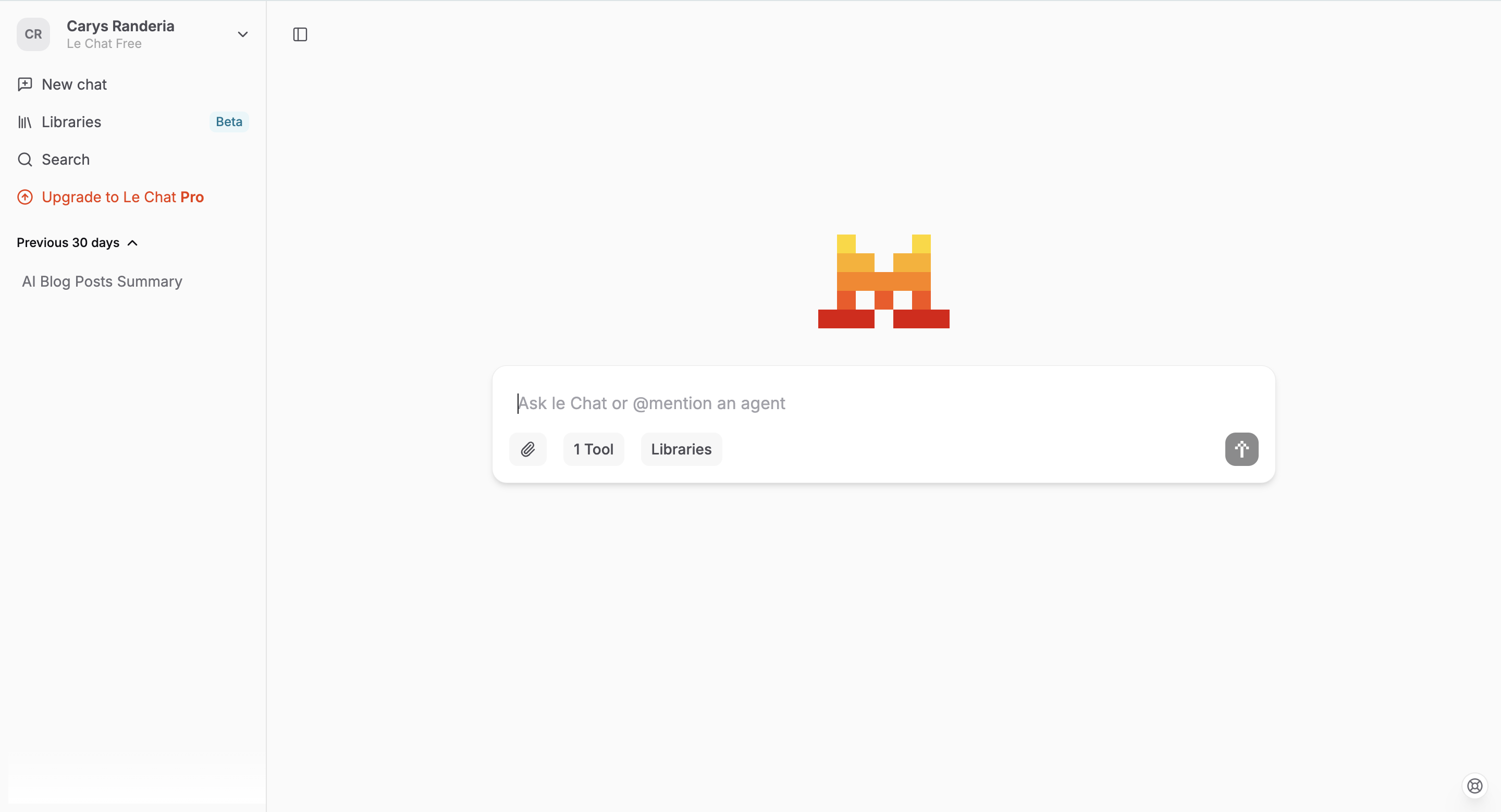
Mistral’s Le Chat welcome screen
Mistral is a French artificial intelligence with open-source AI models at the centre of their mission. In June 2023, just weeks after it was founded, it raised $113 million in what was said to be Europe’s largest ever round of seed funding. In 2024, they introduced Le Chat (apparently, pronounced like the French word for cat and not the excellent pun I first thought…) It’s a conversational AI assistant built on their own technology, designed to be fast and freely available (although paid upgrades are available). It integrates features like web search, image generation via Flux Pro, and a Canvas interface that allows you to directly edit content and code within the conversation. Mistral is the fourth highest-valued AI company in the world, whilst Le Chat maintains a reputation as a privacy-conscious alternative to other chatbots.
Task 1: Summarising Tone of Voice
I started by asking both ChatGPT and Le Chat to summarise three blog posts by Taught by Humans. It’s worth doing before asking for a tone of voice prompt, just to double check that the chatbot can actually read the post. Le Chat fell at the first hurdle…
C: Hey, please can you summarise the content of the following three blog posts: [...]
Le Chat: Hello! I'm unable to browse the web or access specific URLs directly. However, you can copy and paste the text from the blog posts here, and I'd be happy to help you summarise them!
A quick run past Laura and she suggested checking the web search tool at the bottom. It worked, but it’s not the most user-friendly for those of us still getting to grips with GenAI.
I then asked both chatbots to summarise the tone of voice of the articles they read. Le Chat gave me the answer I was expecting: a brief paragraph summarising the tone across all three articles. It’s a bit dry but gets to the point quickly which is exactly what I needed. ChatGPT over-egged it. I got a breakdown of each individual article with a subheading summarising the tone. This was followed by the summary I actually wanted at the bottom and a follow-up question. Always eager to please…
Finally, I asked for the prompt itself. ChatGPT got straight to the point, picking up on the human-centered branding at Taught by Humans and that we see our reader as an intelligent friend (yes, that’s you!) I’m increasingly finding my ChatGPT responses a bit over-the-top, and this seems to fit that mould. There’s a lot of flowery and emotive language for something that’s supposed to be functional. [OpenAI has since come out saying one of their updates caused some personality issues]
I liked that Le Chat picked up on the lack of jargon and our mission to make complex topics more accessible. It hasn’t fully understood what a tone of voice prompt aims to do, getting a bit ahead of itself with the “write a blog post” intro.
Le Chat: Write a blog post in an informative, engaging, and conversational tone. Use personal anecdotes and a friendly, approachable style to make complex topics accessible and relatable [...]
ChatGPT: Write in a warm, conversational tone that’s thoughtful and human-centered. The voice should be encouraging and reflective—curious without being overly technical, and confident without being pushy. Use clear, simple language that feels accessible to a wide audience [...]
Task 2: Suggesting a Topic
I asked both chatbots to suggest a new topic for the blog, and Le Chat absolutely took the lead. It churned out eight suggestions and four of them had a clear focus on AI, education and the workplace.
C: Based on the blog posts I've shared, what do you think would be an interesting topic for Taught by Humans to cover?
Le Chat:
- The Ethical Implications of AI in Everyday Life:
- AI and Creativity: Enhancing or Replacing Human Artistry?:
- The Future of Work in an AI-Driven World:
- Experimenting with AI: Practical Tips for Lifelong Learners:
- The Role of AI in Education: Challenges and Opportunities:
- AI and Mental Health: Friend or Foe?:
- The Impact of AI on Small Businesses:
- AI and Sustainability: Can Technology Save the Planet?
Meanwhile, ChatGPT’s suggestion wasn’t on brand at all. Sure, we’re all about the human side of AI but the focus on creative practice isn’t our niche. In an industry that moves this fast, you’ve got to stick to what you know.
C: Based on the blog posts I've shared, what do you think would be an interesting topic for Taught by Humans to cover?
ChatGPT: "How to Stay Human in the Age of AI: Daily Practices for Creativity, Curiosity, and Critical Thinking"
Task 3: Writing a Blog Post
I gave both chatbots the same prompt. I took one of Le Chat’s suggested topics and included ChatGPT’s tone of voice prompt. I signed off with my favourite “British English, no em-dashes” (this is usually saved in my personal ChatGPT account memory).
If you’re currently wondering whether GenAI is about to steal your writing job, you can sleep easy tonight. On a skim read, both responses read clinically, with vague examples and obvious clichés.
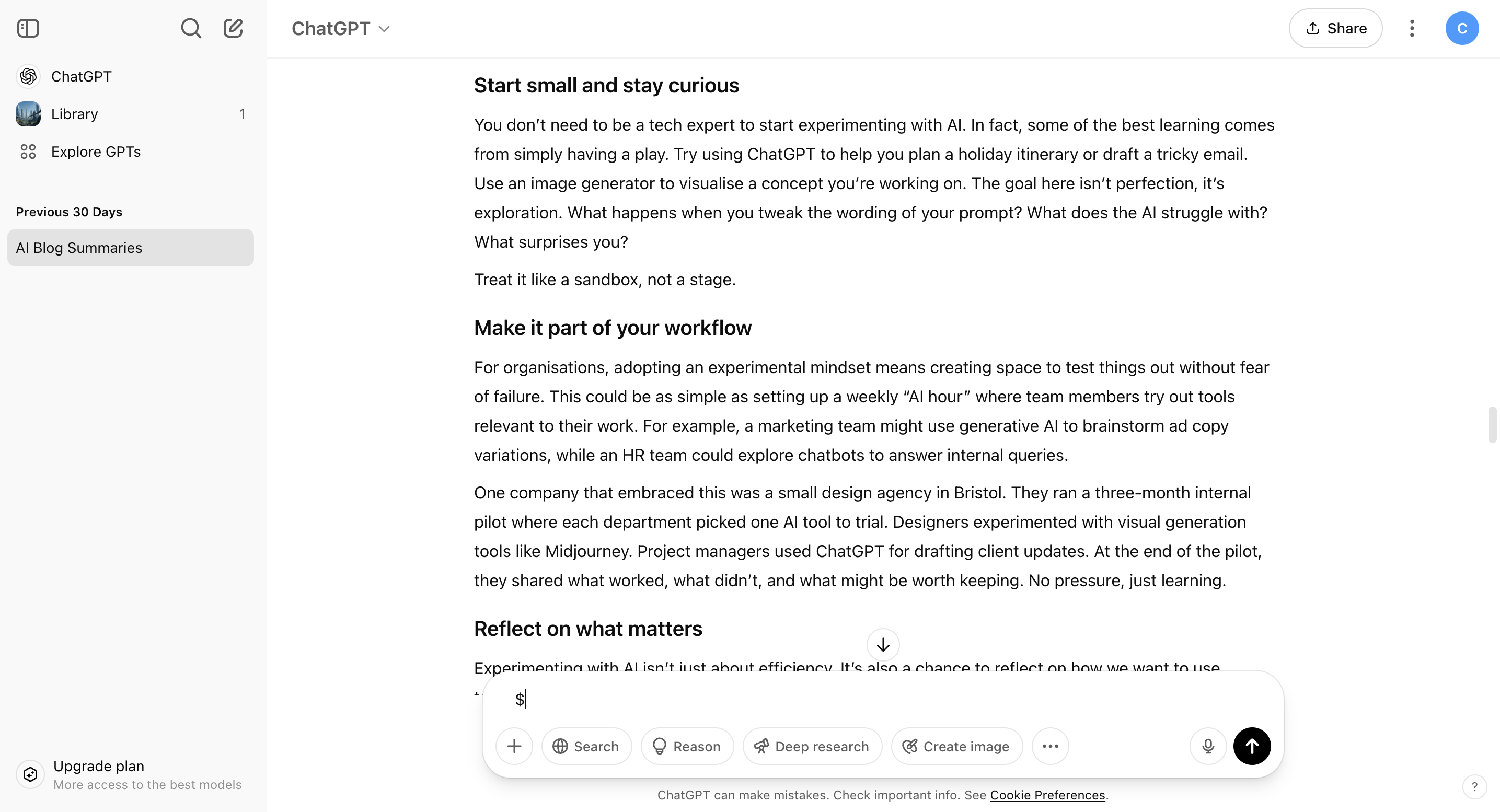
Extract from ChatGPT's attempt
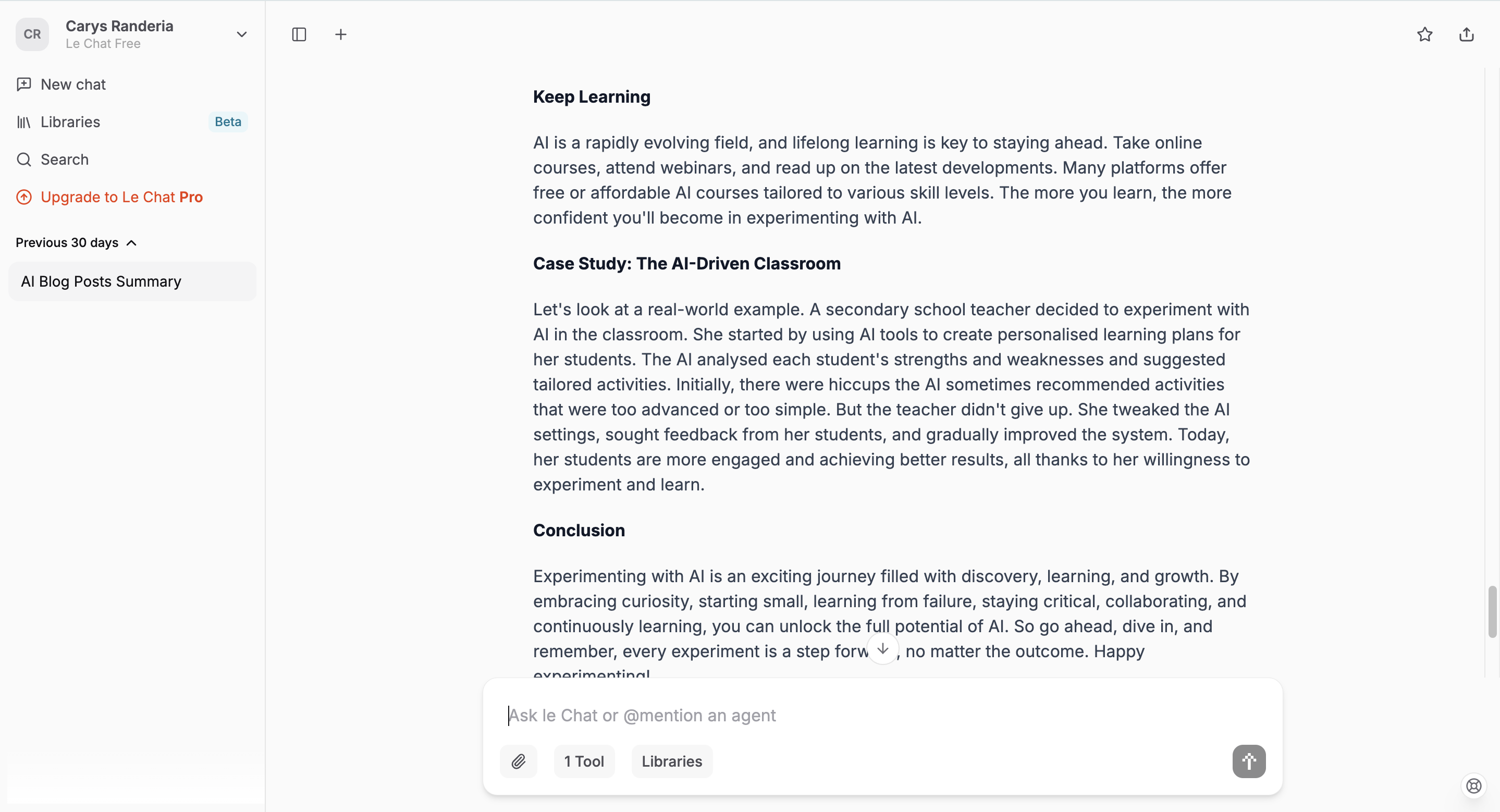
Extract from Le Chat's attempt
I was particularly unimpressed with Le Chat’s “case study” which talks vaguely about “a secondary school teacher.” We aim to make things accessible but we never dumb them down and we support what we’re saying with industry research or personal experience. ChatGPT’s “small design agency in Bristol” is also too vague, but I’ll give them some credit for at least naming the AI tools they’ve implemented (even if one of them is itself…)
I asked both of them to list their sources. Le Chat owned its mistake, admitting the examples were just illustrative (not what I wanted at all). ChatGPT came back to me with the Times and TechUK as its sources. It reminded me of the importance of a well-refined prompt; I definitely should have asked for examples from this year. I really didn’t love that nearly all of its sources were from the same newspaper and that they were paywalled to me (I initially thought that ChatGPT was somehow bypassing paywalls and stealing content, but I have been informed some paywalls are just graphical interfaces, and it’s possible that ChatGPT can still get at the text behind them).
ChatGPT can be its own worst enemy: the blog post is still littered with em-dashes (apparently, it’s not aware that they’re quickly becoming its trademark). “Treat it like a sandbox, not a stage” has the right message at heart but doesn’t really work for me. I’m unsure if they’re referring to the FCA’s Regulatory Sandbox or if it's an americanisation of a child’s sandpit. Either way, our messaging is somewhere in the middle of these extremes. Le Chat’s tone falls into the trap of bossing readers around. It’s heavy on the imperatives: telling everyone what they should be trying, without being able to give any helpful anecdotes about its own experience.
The Result: Will I be Switching?
Both of these posts would need refining before seeing the light of day and both platforms offer a Canvas interface so that you can directly refine text in the chatbot. It’s a limited feature for those of us without a subscription though, and didn’t pop up this time on ChatGPT. I was able to give it a spin in Le Chat, but only after (again!) remembering to select it as a tool before re-writing my prompt.
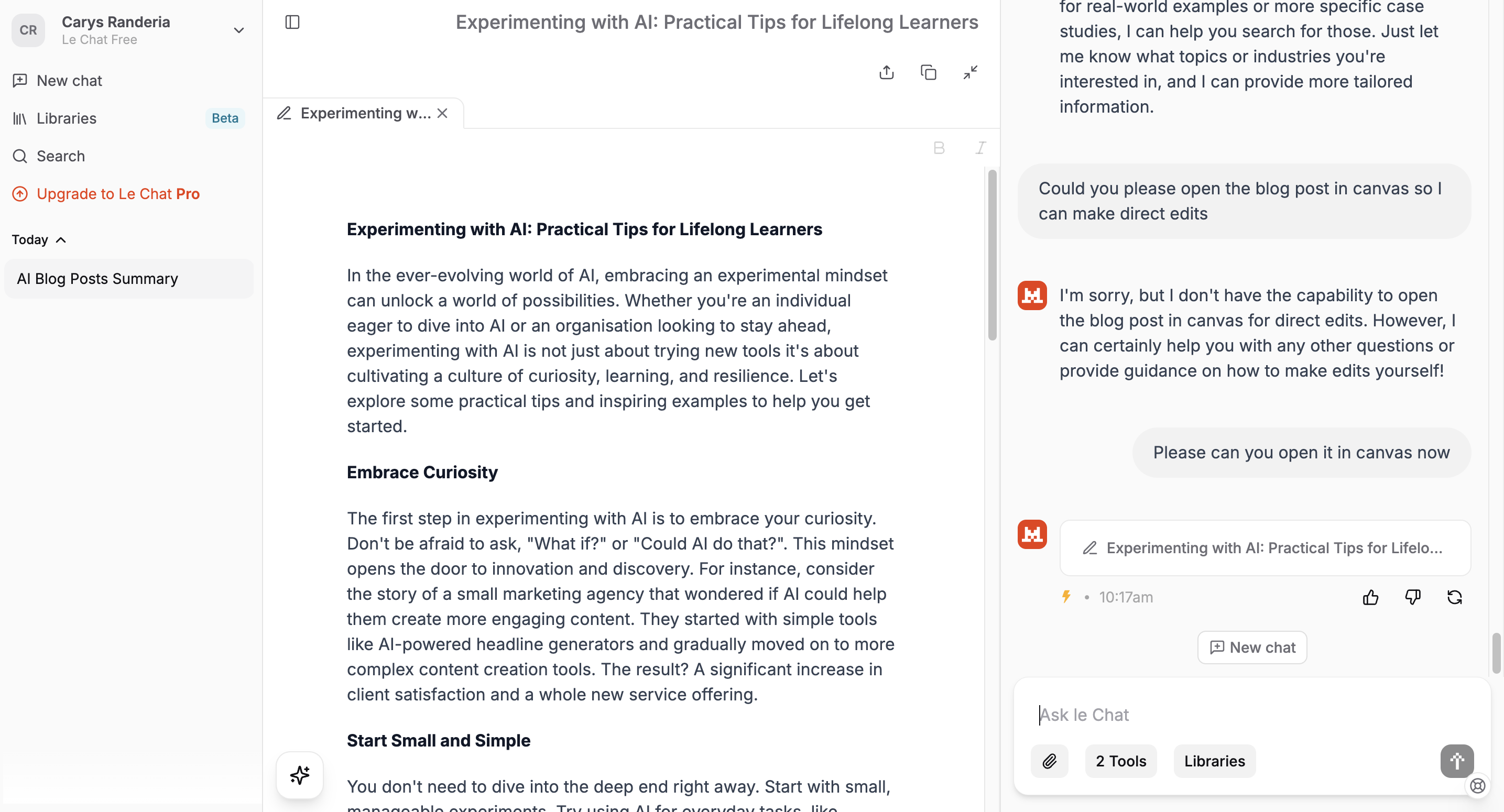
Le Chat’s Canvas allows in-chat editing (once you’ve remembered to select it as a tool!)
I was only playing around with the free versions, and Laura assures me paid ChatGPT is much better. My prompts were pretty generalised and left a lot open to interpretation but I thought Le Chat kept up well with my old friend ChatGPT. On the whole, I preferred interacting with Le Chat: I’m using GenAI with a task in mind, not for a catch up, and I find ChatGPT increasingly prioritising familiarity over functionality. I also wasn’t expecting a bit of experimenting to highlight Le Chat’s edge. I was annoyed that it didn’t pull a real-world example for a blog that loves a personal story but ChatGPT’s limited source selection and ability to read around paywalls didn’t sit right with me. As questions about responsible AI are creeping into the mainstream, it’ll be interesting to see which capabilities users are happy to wave goodbye to in the name of honesty.
More than anything, it’s a reminder to remain curious and up-to-date about alternative chatbots (especially, if you’ve become a bit stuck in your ways, like me).