
It can be hard to look too far into the future of AI because the present is moving so quickly. Attitudes towards AI (especially in the workplace) are a hot topic for surveys, research and reports. In general, people are feeling more positive, but there’s still a dark cloud of general apprehension hanging over the horizon.
Fortunately, recent research by governments, industry leaders and non-profits have done at least some of the work for us and I’ve written a summary of three potential scenarios:
Worst Case Scenario: AI Futures’ AI 2027
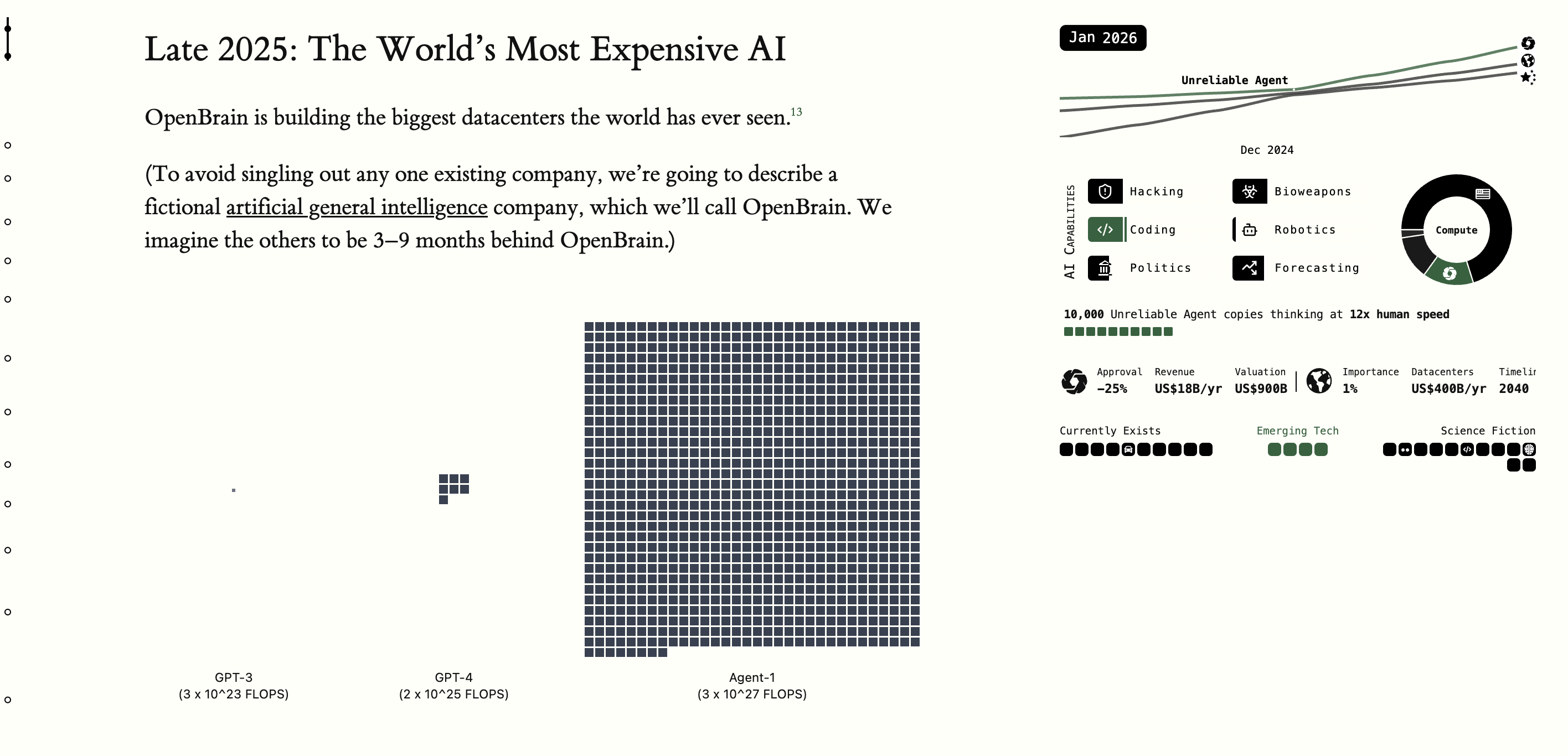
Screenshot from AI Futures’ AI 2027 showing the rapid growth of AI by the end of this year
Beautiful presented, less beautiful messaging: AI 2027 imagines the rapid emergence of superhuman AI by 2027. Yes, that’s just 2 short years away.
It starts steadily with price points of AI agents and government bureaucracy preventing widespread adoption at industry or national level. But something starts to change around the end of 2026, as AI begins to lead its own research and development. The researchers behind the project warn that things get a little harder to predict at this point, but the future they paint is a wild one.
The following saga traces AIs trajectory throughout 2027 and reads like something between the space race and Star Wars. By the beginning of the year, AI agents are not just tools, they’re autonomous. Human engineers still matter, but mostly to steer swarms of AI copies through complex, abstract goals. The clear advantage that AI could offer in terms of defence and cybersecurity means that weights theft across international borders becomes inevitable (this is when countries steal the weights of AI models). By Spring 2027, debates about the rapidly-arriving future heat up: the AI can output in seconds what takes humans days to verify, but its honesty is opaque. As the year rolls on, we see the first self-improving systems and public unease over job loss reaches an all-time high. By September, we have an agent better at AI research than any human alive but it’s unable to admit to itself if it’s being honest. It’s not just science fiction, it’s a countdown.
Best Case Scenario: Microsoft World Trend Index Annual Report
Screenshot from Microsoft’s “World Trend Index Annual Report” promises that 2025 is the year of the Frontier Firm
If AI 2027 feels like a sci-fi thriller, Microsoft’s Frontier Firms are the corporate manual for surviving it. This vision splits the future of work into three distinct phases:
- Each human uses an AI assistant that helps them work faster
- Agents join teams as digital colleagues, taking on specific tasks under human direction.
- Human led, agent-operated teams in which humans set directions and agents complete the tasks.
In this world, employees aren’t replaced, they’re promoted to and oversee fleets of AI that automate tasks and vastly improve efficiency. They promise speed, adaptability, and the potential to add value faster. Unfortunately, there’s still a catch: it’s a workplace that’s radically different, but reskilling isn’t optional. Microsoft warns that this isn’t a distant horizon, the first of these firms are already in motion.
A Happy Medium: Department of Science, Innovation and Technology AI 2030 Scenarios
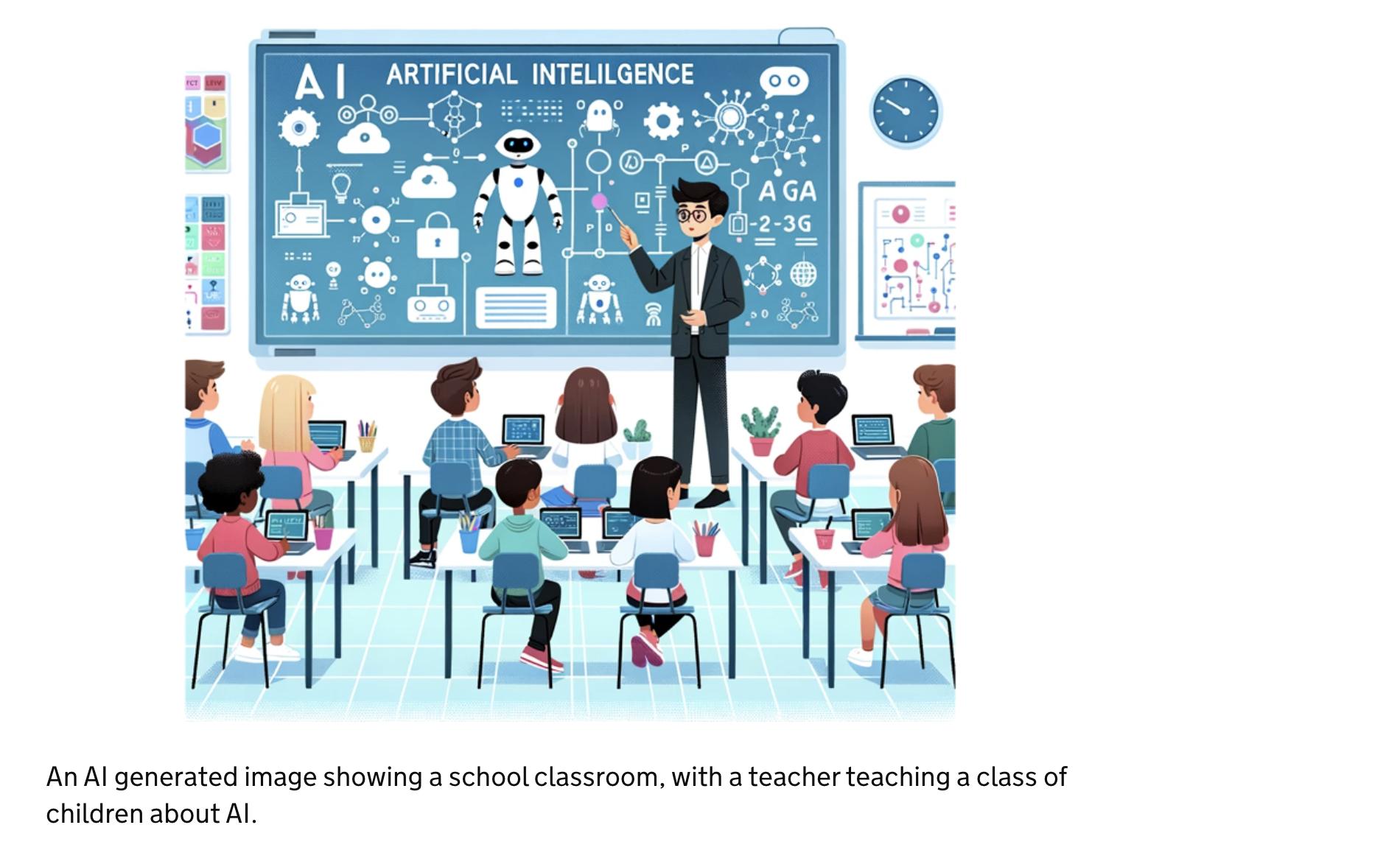
Screenshot from DSIT’s “AI 2030 Scenarios” showing the fun that they had with AI image generation
This report from the Department of Science, Innovation and Technology is a little more playful than your average Government report. They take the future of AI very seriously, and some of it’s pretty bleak, but they’ve peppered it with AI-generated images of each scenario and taken time to explore the positives too. Based on their analysis, there are five possible AI futures:
- Unpredictable Advanced AI: Open-source frontier AI models are released widely, but their unpredictability leads to some unintended consequences. While benefits exist, they are overshadowed by the lack of safety mechanisms in place across the globe. This one’s not far off what AI 2027 predicted for us.
- AI Disrupts the Workforce: Narrow but powerful AI tools, controlled by large tech firms, are widely rolled out and disrupt the workforce. This is what Microsoft thinks the future of work has in store for us. Businesses definitely benefit, as do those who can reskill quickly, but mass job displacement could cause public backlash.
- AI ‘Wild West’: A chaotic environment where a mix of moderately capable AI systems are all on the market. Governments around the world struggle to keep tabs on things.
- Advanced AI on a Knife’s Edge: Frontier systems with general capabilities are deeply embedded in economies and daily life. One model may have reached Artificial General Intelligence (AGI), but it’s now so complex and capable that no one can fully assess its behavior across all domains.
- AI Disappoints: We have to consider a scenario where AI progress just plateaus. Advanced GenAI models remain dominant, but expectations of AGI are unmet. Investors look elsewhere, and adoption varies across sectors. This is a huge contrast with anything AI 2027 or Microsoft predict and a reminder that AI progress is neither linear nor inevitable.
Back to the Future
Unfortunately, even ChatGPT doesn’t have a crystal ball (however much it might seem to know). None of these AI futures are inevitable, and there’s probably a little bit of truth in each of them. The more dystopian predictions of AI 2027 is a good reminder that regulation needs to keep up with innovation, and Microsoft’s sunnier outlook would still be a huge upheaval that would be difficult to stomach for some.
One thing is for sure, AI is already making its mark on the world and whichever future plays out, it’s going to represent a big shift in the way we work. The time to reskill is now, as is the time to build frameworks that place trust and transparency at the heart of the workplace. Don’t wait for AI to change your workplace - that future is already here.